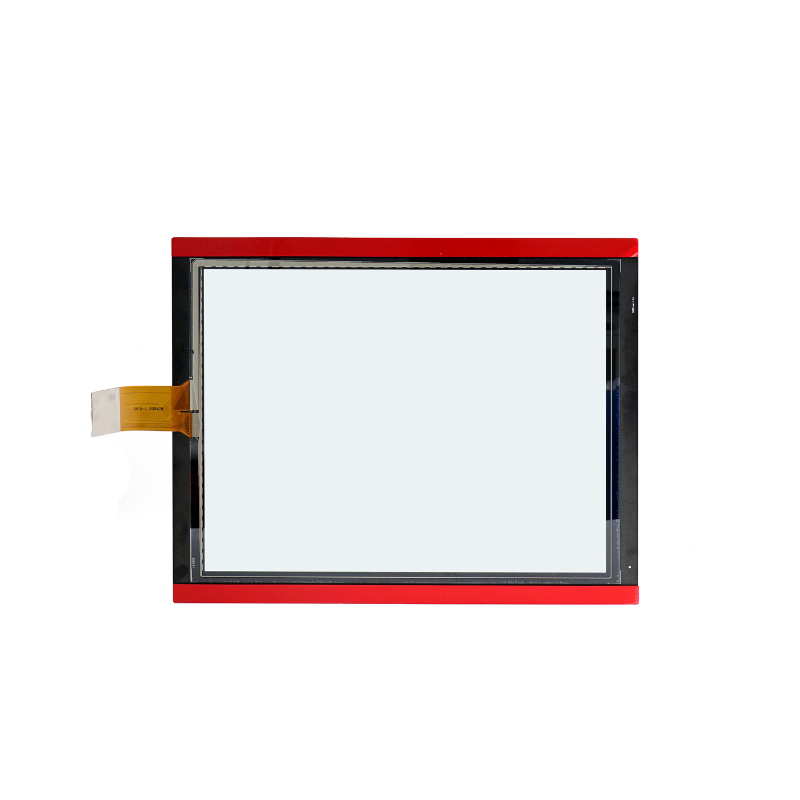

Them Unbeatable?
In the consumer electronics sector, capacitive touch screens have become the mainstream thanks to their sensitive multi-touch capabilities. However, in professional environments such as industrial control, medical equipment, and embedded systems, resistive touch screens have always maintained an irreplaceable position.
They don’t pursue “flashy” interactive experiences, yet they can operate stably in complex conditions like oil contamination, low temperatures, and strong sunlight, serving as the “invisible cornerstone” of countless professional devices.
As an enterprise deeply rooted in the industrial electronics field for over a decade, we have accumulated extensive frontline practical experience in the R&D, production, and scenario adaptation of resistive touch screens. We have also witnessed how they have become a “must-have choice” for professional scenarios.
I. Resistive Touch Screens: The “Tough-as-Nails Champions” of Industrial Settings – What Makes Them Unbeatable?
Many people’s perception of resistive touch screens is still stuck in the “old mobile phone screen” era, but industrial-grade resistive touch screens are already “professional devices” after technological iterations.
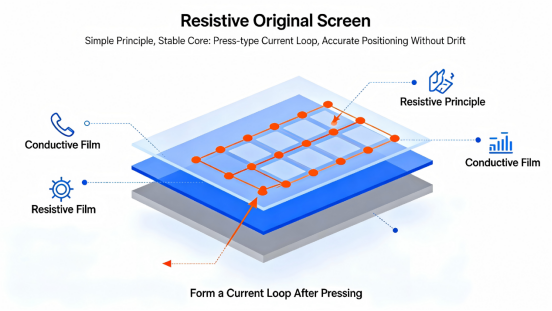
Their touch principle is simple – like “two layers of conductive ‘plastic wrap'”. When pressed, the two layers stick together to form an electric circuit, enabling precise positioning of the touch point.
1. Core Parameter Breakdown: Each Parameter Corresponds to a “Pain Point Solution” for Industrial Scenarios
The requirements for resistive touch screens in industrial scenarios go far beyond just “being touchable”. Our QW-DZ series resistive touch screens have been designed with targeted features for professional scenarios during R&D – behind each parameter lies a solution to real-world usage pain points:
▶️ Size Coverage and Customization Flexibility: Covering standard sizes from 3.5 inches (suitable for small embedded devices and portable medical instruments) to 22 inches (suitable for industrial all-in-ones and large control consoles); also supporting on-demand customization of special-shaped sizes (such as non-standard rectangular screens required for equipment integration and curved special screens), and even adjusting screen thickness according to equipment installation space (standard 1.4-2.2mm, with customized versions as thin as 1.2mm).
▶️ Hardcore Data on Environmental Resistance: Passed high and low temperature cycle tests of -40℃~70℃ (standard models have a default operating temperature of -10℃~60℃, and can be customized to withstand low temperatures down to -20℃ for cold chain, outdoor, and other scenarios), with a humidity resistance range of 10%~90% (non-condensing). Even in workshop environments during the rainy season in southern China or outdoor operating conditions in northern China’s winter, touch failure can be avoided. In addition, the screen surface is coated with a scratch and wear-resistant layer with a hardness of ≥3H, capable of resisting daily wear and tear such as tool collisions and dust friction.
▶️ Durability Indicators Stand the Test: 4-wire resistive touch screens have a single-point touch life of ≥30 million times, and 5-wire resistive touch screens have a life of ≥50 million times. Our quality control includes an additional 10% durability test – simulating high-frequency touch scenarios of 1,000 touches per day for industrial equipment. As a result, some batches of products can achieve a service life of 60 million times, which exactly covers the 3-5 year usage cycle of industrial equipment,
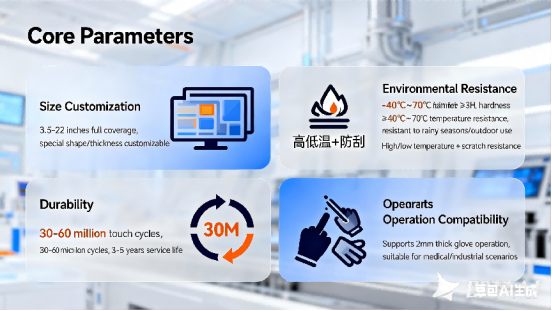
▶️ Operational Compatibility for Diverse Needs: Supports operation with fingers, styluses, and work gloves up to 2mm thick. This is also a “must-have” for scenarios such as medical care, maintenance, and industrial production – it’s hard to imagine medical staff removing their gloves to operate emergency equipment, or maintenance workers accurately touching capacitive screens with their fingers in oil-contaminated environments. The operating logic of resistive touch screens perfectly solves these “interactive challenges in special scenarios”.
Core Conclusion: The core of industrial resistive touch screen parameters is “adaptability” – size, temperature resistance, and durability are all designed around scenarios, rather than simply stacking data. These parameters are not for “showing off”. For example, the -20℃ low-temperature resistance design can help you save on equipment modification costs for cold chain scenarios; the 60 million-time durability ensures you won’t need to replace the screen for 3-5 years, reducing operation and maintenance costs.
2. 4-Wire vs. 5-Wire Resistive Touch Screens: Choosing the Right Type Is More Important Than Choosing the “Expensive One”
You might ask: “Between 4-wire and 5-wire resistive touch screens, which one should I choose?” In fact, there’s no absolute good or bad – the key lies in your scenario requirements, avoiding “overconfiguration waste” or “underconfiguration failure to meet expectations”. The specific differences between the two are clearly shown in the table below:
| Comparison Dimension | 4-Wire Resistive Touch Screen | 5-Wire Resistive Touch Screen | Suitable Scenarios |
| Touch Life | ≥30 million times | ≥50 million times (up to 60 million times for some models) | – |
| Positioning Accuracy | ±1mm | ≤0.5mm | – |
| Operation Experience | Basic touch, response ≤20ms | Precise touch, strong anti-interference | – |
| Procurement Cost | Lower (30% cheaper than 5-wire screens) | Higher | – |
| Suitable Scenarios | Convenience store POS systems, simple sorting equipment, basic embedded panels | Industrial control, medical equipment, automotive production line control consoles | ✅ Choose 4-wire for simple scenarios, 5-wire for precise and high-frequency use |
We provided 7-inch 4-wire resistive touch screens for a chain of convenience stores. With a daily touch frequency exceeding 2,000 times, the average service life of a single screen reached 4 years, far exceeding the customer’s expected 2-year cycle. For the final assembly workshop of a major automotive manufacturer, we supplied 15-inch 5-wire resistive touch screens. Under the high-intensity usage of 24/7 continuous operation and 3,000 daily touches, there were no issues such as touch drift or failure for 3 years, and the equipment stability rate increased by 98%.
Selection Mantra: “Choose 4-wire for simple scenarios, 5-wire for precise and high-frequency use”. Make a comprehensive judgment based on usage frequency, accuracy requirements, and budget – there’s no need to blindly pursue high configurations.
II. 3 Real Cases: How Resistive Touch Screens “Save the Day” in Scenarios Where Capacitive Screens Fail
Many of our customers have “switched back to resistive touch screens from capacitive ones” – not because capacitive screens are bad, but because the special pain points of professional scenarios can only be accurately solved by resistive touch screens. These real cases have also made us more clearly see the irreplaceability of resistive touch screens in the industrial field.
Case 1: The “Oil Contamination and Glove Dilemma” in Automotive Final Assembly Workshops
The final assembly workshop of a leading automotive manufacturer once equipped its equipment operation terminals with capacitive screens, initially envisioning “more sensitive operation”. However, problems frequently arose in actual use: engine oil and coolant in the workshop would adhere to the screen surface, causing capacitive touch screens to fail; when workers operated with work gloves, capacitive touch screens could not recognize touch commands at all.
Workers had to frequently wipe the screens or remove their gloves to operate, which not only affected production efficiency but also posed safety hazards – removing gloves to operate mechanical buttons might delay reaction time.
After understanding the customer’s pain points, we customized 10.4-inch 5-wire resistive touch screens for them, making two major optimizations for the workshop scenario: first, adding an oil-resistant coating to the screen surface, allowing touch to be restored with simple wiping after oil contamination; second, enhancing pressure sensing sensitivity to enable precise touch even with thick gloves.
After the replacement, the equipment failure rate dropped from 8 times per month to 0, the daily output of a single production line increased by 5%, and worker operation satisfaction rose from 65 points to 92 points.
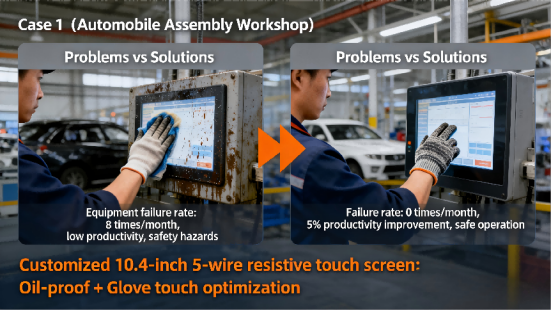
Core Case Value: For oil-contaminated and glove-operated scenarios, resistive touch screens can reduce the equipment failure rate from 8 times/month to 0, increase production capacity by 5%, and avoid operational safety hazards.
If the oil-contaminated scenario in automotive workshops tests the “pollution resistance” of resistive touch screens, then the low-temperature environment of cold chain logistics is the ultimate test of their “adaptability to extreme environments”.
Case 2: The “Low-Temperature Test” in Outdoor Cold Chain Logistics
An outdoor sorting equipment of a cold chain logistics enterprise needed to operate in a low-temperature environment of -15℃ (for frozen food sorting). The previously used capacitive screens experienced severe touch delays at low temperatures – the response time increased from the normal 8ms to more than 50ms, and even occasional failures occurred, leading to an increase in sorting error rates and a higher risk of cargo backlogs.
We customized a low-temperature resistant version of the 7-inch 4-wire resistive touch screen for them: on the one hand, optimizing the screen’s conductive material to ensure stable current conduction even in -20℃ environments; on the other hand, adding an anti-frost coating to prevent frost formation on the screen surface in low-temperature environments, which could affect visibility and touch.
After the transformation, the equipment operated continuously for 12 hours in a -15℃ environment, with a stable touch response within 15ms. The sorting error rate decreased from 3% to 0.5%, and the sorting efficiency increased by 12%, fully meeting the strict requirements of cold chain logistics.
Core Case Value: Low-temperature resistant customized resistive touch screens can adapt to extreme environments of -20℃, solving the problem of capacitive screen failure at low temperatures and controlling the sorting error rate within 1%.
Case 3: “Operational Adaptability and Durability Requirements” for Grassroots Medical Equipment
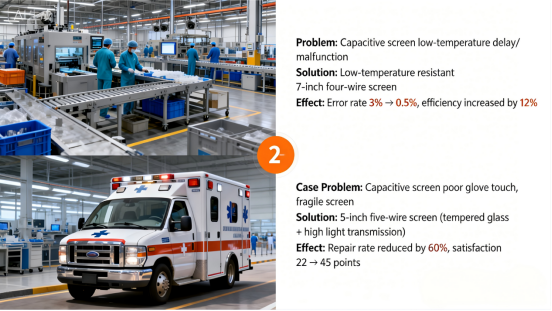
We customized a 5-inch 5-wire resistive touch screen for them, specifically addressing two major pain points: first, supporting glove operation, allowing medical staff to quickly adjust parameters without removing their gloves; second, using a reinforced glass substrate, increasing impact resistance by 30% to cope with frequent movement and slight collisions in emergency scenarios. In addition, the screen transmittance was optimized to 82%, enabling medical staff to clearly see screen data even in strong light environments in ambulances.
After replacing with resistive touch screens, the user satisfaction of the equipment increased from 82 points to 95 points, the maintenance rate decreased by 60%, and it became the main monitoring equipment in grassroots hospitals.
Core Case Value: Customized resistive touch screens for medical scenarios can adapt to glove operation and strong light environments, while improving impact resistance, reducing equipment maintenance rates by 60%, and significantly enhancing user satisfaction.
Key Summary: The core competitiveness of resistive touch screens lies in “solving pain points in special scenarios” – environments such as oil contamination, low temperatures, and glove operation that capacitive screens struggle to handle are exactly the advantage areas of resistive touch screens. This is also the core reason why they are irreplaceable in industrial scenarios.
III. Selection Pitfall Avoidance Guide: 90% of Enterprises Choose the Wrong Resistive Touch Screens Due to These 3 Mistakes
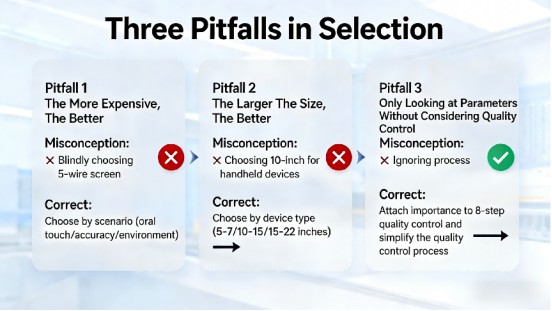
After reading these 3 cases, you probably have a clear understanding of the advantage scenarios of resistive touch screens. However, choosing the right resistive touch screen requires more than just knowing its advantages – many enterprises clearly choose the right type but end up with poor user experience because they fall into selection pitfalls. Based on years of customer service experience, we have summarized 3 high-frequency pitfalls to help you make the right choice without mistakes:
Pitfall 1: “The More Expensive, the Better” – 5-Wire Screens Are Not Suitable for All Scenarios
Many customers believe that “5-wire screens are better than 4-wire screens, so just choose 5-wire screens”. However, in reality, if the equipment is used in indoor scenarios with no oil contamination, low touch frequency, and low accuracy requirements (such as convenience store POS machines and simple data collection terminals), 4-wire resistive touch screens can fully meet the needs. Blindly choosing 5-wire screens will increase procurement costs by 30% without bringing actual use value.
✅ Correct Approach: First clarify the usage scenario – touch frequency (whether it exceeds 1,000 times per day), accuracy requirements (whether precise clicking on small icons is needed), and whether the environment is complex (presence of oil contamination, low temperatures, etc.), then select the type. For example, in scenarios with less than 500 touches per day and an accuracy requirement of ±1mm, 4-wire screens offer higher cost-effectiveness; in industrial control scenarios with more than 1,000 touches per day and an accuracy requirement of ±0.5mm, choose 5-wire screens.
Pitfall 2: “The Larger the Size, the Better” – It Must Match the Equipment’s Operating Logic
A customer once requested to replace the 7-inch screen of an embedded device with a 10-inch one, believing that “a larger screen makes operation more convenient”. However, in actual use, it was found that the device was operated handheld, and the large-size screen increased the device weight from 0.8kg to 1.5kg, causing medical staff to easily fatigue when holding it for a long time. At the same time, the large-size screen exceeded the device’s installation space, requiring subsequent modification of the device structure and delaying the project progress.
✅ Correct Approach: Choose the size according to the device type – 5-7 inches for handheld devices (such as portable medical instruments and handheld data collectors) to balance portability and operational convenience; 10-15 inches for fixed terminals (such as workshop control consoles and industrial all-in-ones) to meet the needs of multi-icon operation; 15-22 inches for large monitoring terminals (such as factory master control screens) to adapt to multi-person collaboration scenarios. In addition, confirm the size of the equipment installation space in advance to avoid “the screen being too large to install” or “the screen being too small for convenient operation”.
Pitfall 3: “Only Looking at Parameters, Ignoring Quality Control” – Details Determine Long-Term Stability
Why do resistive touch screens from some small manufacturers have the same parameters as those from large manufacturers but frequently have problems in actual use? The core reason is the lack of quality control processes. “Meeting parameter standards” is only the foundation for resistive touch screens; quality control is the “lifeline” for industrial scenarios.
Our resistive touch screens undergo 8 strict quality control processes from production to delivery: raw material inspection (core materials such as conductive films and glass substrates must meet industrial-grade standards) → lamination accuracy testing (ensuring the lamination error of the two layers of film is ≤0.1mm) → high and low temperature cycle testing (simulating extreme environments) → durability testing (simulating high-frequency touch scenarios) → interface compatibility testing (adapting to commonly used RS232 and USB interfaces for industrial equipment) → dust and water resistance testing (coping with workshop dust and humid environments) → finished product sampling aging (randomly selecting 10% of products for 72-hour continuous operation testing) → factory calibration (ensuring touch accuracy meets standards). The defective rate of each batch is strictly controlled within 0.1% – this is also the core reason why our products can enter the supply chains of well-known enterprises such as Siemens, Panasonic, and Hikvision.
Key Summary: Three key factors for selection: matching scenario type, adapting to equipment size, and emphasizing quality control processes – all three are indispensable. Avoiding these 3 pitfalls can not only help you select an “adaptable resistive touch screen” but also save 30% on procurement costs and reduce 80% of subsequent maintenance troubles.
IV. The Future of Resistive Touch Screens: Not Being Replaced, but Becoming More “Professional”
With the advancement of Industry 4.0, some people believe that “resistive touch screens will be eliminated by capacitive touch screens”. However, the actual situation is: resistive touch screens are evolving towards “more segmented professional scenarios”, continuously consolidating their advantage areas through technological upgrades, rather than competing with capacitive touch screens in the consumer market.
For example, we are developing a “corrosion-resistant resistive touch screen” that uses a special conductive coating and sealing process to adapt to the acid-base environment of chemical workshops, solving the pain point of traditional resistive touch screens being easily corroded in chemical scenarios. There is also the “high-transmittance resistive touch screen”, which increases transmittance from the conventional 78%-82% to 85% through optimized coating technology, balancing visibility and durability in industrial scenarios, enabling clear display even in strong light environments.
In addition, in response to the needs of the Industrial Internet of Things, we are integrating touch data collection functions into resistive touch screens, which can real-time record touch frequency, operation trajectories, and other data to support equipment operation and maintenance and process optimization.
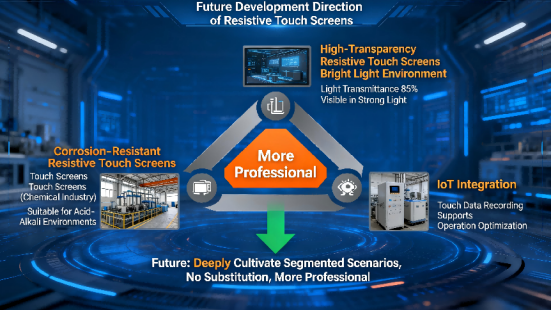
For professional equipment, “stability” is always the top priority – the value of resistive touch screens lies in their ability to steadily complete every touch in scenarios where others “can’t hold on”. This is not “backwardness”, but another form of “professionalism”: it does not pursue “interactive pleasure” in the consumer market, but focuses on “reliable output” in industrial scenarios, becoming the “invisible support” behind countless professional devices.
As an enterprise deeply engaged in the industrial electronics field, we have always adhered to the R&D concept of “scenario-centric”, continuously optimizing the technology and performance of resistive touch screens based on customers’ actual needs. Up to now, our QW-DZ series resistive touch screens have covered more than 10 segmented fields such as industrial automation, medical equipment, retail terminals, cold chain logistics, and automotive manufacturing, serving customers in more than 20 countries and regions around the world, and winning industry recognition with stable quality.
Conclusion
In an era pursuing “high technology and new experiences”, resistive touch screens may seem somewhat “low-key”, but their “reliability and adaptability” in industrial scenarios are exactly their irreplaceable core value. Whether it’s the oil-contaminated environment of automotive workshops, the low-temperature test of cold chain logistics, or the glove operation requirements of medical equipment, resistive touch screens use their own way to ensure the stable operation of professional scenarios.
Choosing an industrial resistive touch screen essentially means choosing a “long-term stable user experience” and “lower operation and maintenance costs”. If you are selecting a resistive touch screen for industrial equipment, it is advisable to start from scenario needs and make a comprehensive judgment based on factors such as size, type, and quality control.
Have you ever encountered problems such as “capacitive screen failure in special environments”? Welcome to share your scenarios in the comment section, and we will help you analyze whether a resistive touch screen is suitable. At the same time, to help you quickly select the right product, we have compiled the “Industrial Resistive Touch Screen Scenario Selection Comparison Table”, which includes the optimal choices, size recommendations, and cost calculations for more than 10 segmented scenarios. To obtain it, reply “Selection” in the comment section!