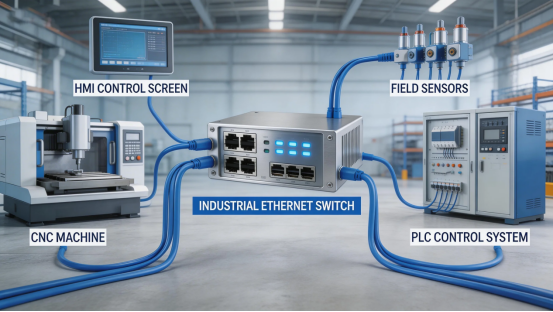

In the current wave of industrial digital transformation, stable, high-speed, and secure network transmission is the core prerequisite for industrial automation, IoT deployments, and smart factory operations. From equipment connectivity on manufacturing floors to data transmission in medical facilities, and from remote monitoring in outdoor industrial settings to confidential communications in the defense sector, industrial Ethernet switches serve as the “backbone” of industrial-grade networks, playing a critical role in connecting devices, transmitting data, and ensuring network stability. This guide comprehensively explores the core value, product classifications, key advantages, U.S. industry application cases, and how to select industrial Ethernet switches that meet enterprise needs—helping U.S. businesses build efficient, reliable industrial-grade network architectures.
1. What is an Industrial Ethernet Switch?
An industrial Ethernet switch is a network switching device specifically designed for harsh industrial environments. Its core function is to enable high-speed data transmission, signal forwarding, and network management between industrial devices (sensors, PLCs, robots, monitoring equipment, etc.). Unlike standard commercial Ethernet switches, it offers enhanced environmental adaptability, stability, and anti-interference capabilities, meeting the rigorous 24/7 operational requirements of industrial settings.
Standard commercial switches are prone to freezing, disconnection, or even damage in industrial environments due to extreme temperatures, dust, vibration, and other factors. In contrast, industrial Ethernet switches undergo specialized ruggedization, allowing them to easily handle the complex challenges of industrial sites and serving as the core infrastructure for industrial network deployment.
The core features of industrial Ethernet switches include:
- Rugged Construction: Equipped with industrial-grade enclosures that resist dust, moisture, and electromagnetic interference (EMI), capable of withstanding physical shocks and vibrations in industrial environments.
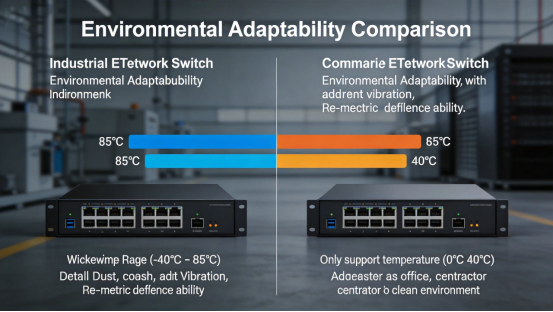
- Wide Temperature Adaptability: Operates within a temperature range of -40°C to 85°C, making it suitable for extreme industrial environments such as high and low temperatures without the need for additional cooling or heating equipment.
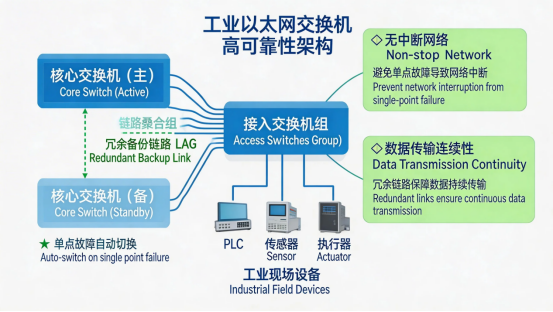
- Stability and Reliability: Supports redundancy backup, link aggregation, and other features to prevent network interruptions caused by single-point failures, ensuring the continuity and integrity of data transmission.
- Long-Term Durability: Boasts a product lifecycle of 5–10 years, adapting to the long-term deployment needs of industrial equipment and supporting compatibility with legacy systems and future upgrades.
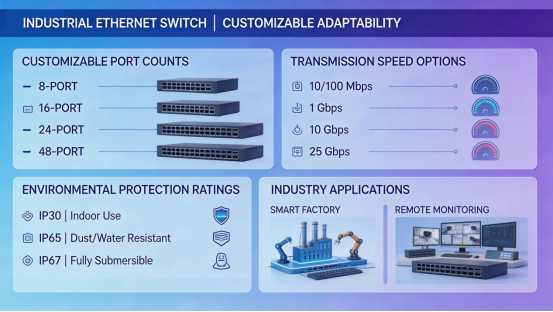
- Customizable Adaptability: Can be customized in terms of port count, transmission speed, and protection level to meet diverse needs—such as industrial IoT and automation control—across various industry scenarios.
Industrial Ethernet switches are not merely “upgraded versions” of commercial switches; they are specialized devices tailored to industrial scenarios. Their core value lies in resolving network transmission challenges related to stability, security, and compatibility in industrial environments, providing robust network support for industrial digital transformation. Whether for equipment connectivity in smart factories or data transmission in remote monitoring systems, industrial Ethernet switches are indispensable core components.
2. Core Classifications and Application Scenarios of Industrial Ethernet Switches
Based on the diverse needs of industrial scenarios, industrial Ethernet switches can be divided into several types, each with unique functions and application use cases. Choosing the right classification is critical to ensuring the efficient operation of industrial networks. The following details the mainstream classifications and their respective application scenarios:
Managed Industrial Ethernet Switches
Managed industrial Ethernet switches are the most comprehensive type, supporting network management, configuration, and monitoring. They allow real-time control of network ports, transmission speeds, and link status via web interfaces, CLI command lines, and other methods. Equipped with advanced features such as redundancy backup, VLAN segmentation, and QoS prioritization, they can flexibly adapt to complex industrial network architectures.
Application Scenarios:
- Core networks for equipment connectivity in large smart factories across the U.S.
- Large-scale industrial Internet of Things (IIoT) device deployment scenarios
- Industrial environments with high requirements for network stability and manageability (e.g., automotive manufacturing, semiconductor production in U.S. facilities)
- Distributed industrial networks spanning multiple regions and devices
Core Advantages: Flexible configuration of network parameters, real-time network status monitoring, timely fault diagnosis, support for network expansion and upgrades, and adaptability to the dynamic needs of complex industrial scenarios.
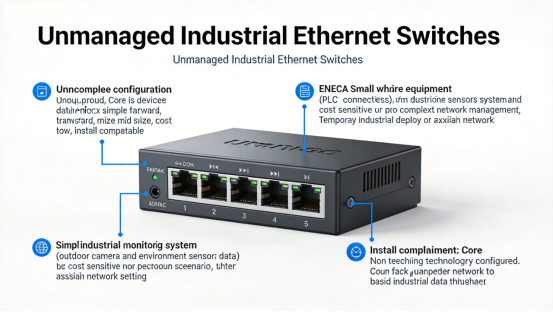
Unmanaged Industrial Ethernet Switches
Unmanaged industrial Ethernet switches require no complex configuration and are plug-and-play. Their core function is simple data forwarding between devices, featuring a compact size, low cost, and easy installation. They are ideal for industrial scenarios with basic network function requirements and a small number of devices.
Application Scenarios:
- Equipment connectivity in small workshops (e.g., sensor and PLC connections on a single production line in U.S. small manufacturing businesses)
- Simple industrial monitoring systems (e.g., data transmission for outdoor cameras and environmental sensors at U.S. outdoor industrial sites)
- Cost-sensitive scenarios that do not require complex network management
- Temporary industrial deployments or auxiliary network construction
Core Advantages: Easy installation, low cost, no need for professional technical personnel for configuration, enabling rapid network setup to meet basic industrial data transmission needs.
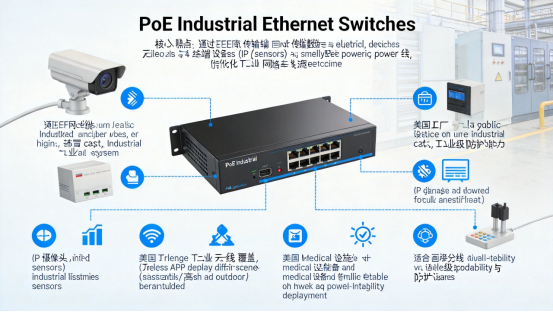
PoE Industrial Ethernet Switches
Power over Ethernet (PoE) industrial Ethernet switches can transmit both data and power through Ethernet cables, eliminating the need for separate power cords for end devices (e.g., IP cameras, wireless APs, sensors). This significantly simplifies the wiring process for industrial networks, reduces deployment costs, and simultaneously offers industrial-grade protection capabilities.
Application Scenarios:
- Industrial monitoring systems (IP cameras, infrared sensors) in U.S. factories and public facilities
- Industrial wireless coverage (wireless AP deployment) in U.S. industrial parks
- Industrial scenarios with difficult wiring (e.g., high-altitude, outdoor, and remote areas in the U.S.)
- Integrated network and power deployment for medical equipment and smart meters in U.S. healthcare facilities
Core Advantages: Integrated data and power transmission, simplified wiring, reduced deployment and maintenance costs, compatibility with hard-to-wire industrial scenarios, and industrial-grade stability and protection.
When selecting an industrial Ethernet switch, U.S. businesses should choose the appropriate type based on the number of industrial devices, network complexity, wiring conditions, and cost budget in their specific industrial scenarios—ensuring efficient, stable, and adaptive network transmission.
3. Core Advantages of Industrial Ethernet Switches: Why Industrial Scenarios Must Choose Industrial-Grade Products?
In industrial environments, commercial Ethernet switches cannot meet the demands of long-term stable operation. Industrial Ethernet switches, with their unique design and functionality, have become the preferred choice for industrial networks. The following are the core advantages of industrial Ethernet switches—key differentiators from commercial switches:
- Strong Adaptability to Extreme Environments: Industrial Ethernet switches use industrial-grade components and ruggedized enclosures, capable of withstanding extreme temperatures (-40°C to 85°C), high dust, high humidity, strong vibration, and heavy electromagnetic interference. They are well-suited for harsh industrial environments such as manufacturing workshops, outdoor construction sites, mines, and oil fields in the U.S.—where commercial switches are prone to failure.
- 24/7 Uninterrupted Stable Operation: Industrial scenarios demand extremely high network stability; any network interruption can lead to production shutdowns, equipment damage, or even safety incidents. Industrial Ethernet switches support redundancy backup, link aggregation, and other features to avoid single-point failures, achieving 24/7, 365-day uninterrupted operation with a far lower failure rate than commercial switches.
- Secure and Reliable Data Transmission: Industrial data (such as production parameters, equipment status, and medical data) requires the highest levels of confidentiality and integrity. Industrial Ethernet switches support security features such as hardware encryption, access control, and VLAN segmentation, effectively preventing data leakage, tampering, and network attacks—critical for U.S. industries with strict data compliance requirements.
- Strong Compatibility with Industrial Equipment: Industrial scenarios often include a large number of legacy devices and industrial terminals from different brands (PLCs, sensors, robots, etc.). Industrial Ethernet switches support multiple industrial protocols (Modbus, Profinet, EtherNet/IP, etc.), enabling seamless connectivity between diverse devices—something commercial switches often fail to provide.
- Easy Maintenance and Scalability: Industrial Ethernet switches support remote management, fault alerts, and other features, allowing real-time network status monitoring and timely fault diagnosis—reducing on-site maintenance costs. They also support port expansion, enabling U.S. businesses to flexibly scale their networks as needs evolve and adapt to the dynamic requirements of industrial digital transformation.
For U.S. industrial enterprises, choosing an industrial Ethernet switch is not only the foundation for ensuring network stability but also a key step in reducing production risks, improving operational efficiency, and driving digital transformation. Whether it is a small workshop or a large smart factory, industrial Ethernet switches are the core backbone of industrial network construction.
4. Core Differences Between Industrial Ethernet Switches and Commercial Switches
Many U.S. businesses confuse industrial Ethernet switches with commercial switches, assuming they differ only in “application scenarios.” In reality, the two have fundamental differences in design, performance, and functionality. Choosing the wrong type can result in frequent network interruptions, equipment damage, and even disrupt production operations. The following outlines the core differences to help U.S. businesses accurately distinguish between the two and make informed choices:
| Comparison Dimension | Industrial Ethernet Switch | Commercial Ethernet Switch |
| Environmental Adaptability | Wide temperature (-40°C to 85°C), dust, moisture, vibration, and EMI resistance | Room temperature (0°C to 40°C), suitable only for clean environments like offices and data centers |
| Operational Stability | Supports 24/7 uninterrupted operation, redundancy backup, extremely low failure rate | Designed for 8-hour office use, no redundancy, prone to freezing and disconnection during long-term operation |
| Function Adaptability | Supports industrial protocols, VLAN segmentation, PoE power supply, remote management, and customization | Basic data forwarding only, no industrial protocol support, limited functionality |
| Product Lifecycle | 5–10 years, supports legacy device compatibility, ideal for long-term deployment | 2–3 years, rapid obsolescence, not suitable for long-term industrial deployment |
| Security Performance | Hardware encryption, access control, resistant to industrial network attacks | Basic security protection, unable to withstand industrial-grade network threats |
Summary: Commercial switches are suitable for clean, room-temperature, low-load environments such as offices and data centers. In contrast, industrial Ethernet switches are specifically engineered for industrial scenarios, capable of withstanding harsh conditions, ensuring stable operation, and integrating with industrial equipment—making them the only viable choice for U.S. industrial networks.
5. Leading Industrial Ethernet Switch Brands: Hirschmann, Advantech, and Huawei
When selecting an industrial Ethernet switch, a brand’s reliability, technical expertise, and after-sales support are critical—directly impacting network stability and long-term operational costs. Below are three leading global brands in the industrial Ethernet switch market, particularly well-suited for U.S. application needs:
Hirschmann Industrial Ethernet Switches
Hirschmann is a renowned German industrial network brand specializing in industrial Ethernet switches, industrial routers, and related products. It holds a strong reputation and significant market share in the global industrial sector, with products known for their stability and durability—widely used in U.S. automotive manufacturing, rail transit, energy, and other industries.
Core Advantages of Hirschmann Industrial Ethernet Switches:
- Extreme Environment Adaptability: Products are IP67-certified, capable of withstanding strong vibration, high dust, and high humidity—ideal for harsh U.S. scenarios such as outdoor sites, mines, and oil fields.
- Strong Industrial Protocol Compatibility: Supports mainstream industrial protocols like Profinet and EtherNet/IP, enabling seamless integration with diverse industrial equipment used in U.S. factories.
- Advanced Redundancy Technology: Utilizes ring network redundancy, link aggregation, and other technologies with fast network recovery times, ensuring uninterrupted data transmission.
- Global Service Support: Maintains multiple service centers across the U.S., providing timely technical support, firmware updates, and maintenance services to meet the deployment needs of U.S. enterprises.
Hirschmann’s solutions are widely adopted in the U.S. automotive manufacturing and energy industries, establishing it as a benchmark brand in the industrial Ethernet switch space.
Advantech Industrial Ethernet Switches
Advantech is a global leader in industrial automation. Its industrial Ethernet switch products balance stability and cost-effectiveness, catering to the diverse needs of small-to-medium industrial enterprises and large smart factories in the U.S. The brand supports custom development and has widespread deployment in over 100 countries worldwide.
Core Advantages of Advantech Industrial Ethernet Switches:
- Cost-Effectiveness: Competitive pricing with comprehensive functionality, suitable for the budget constraints of small-to-medium U.S. industrial enterprises.
- Flexible Customization: Can be tailored in terms of port count, transmission speed, and protection level to meet the unique needs of different U.S. industrial scenarios.
- IoT Integration-Friendly: Seamlessly connects with Advantech’s IoT platform, helping U.S. enterprises implement intelligent monitoring and management of industrial equipment.
- Strong Compliance: Meets international certifications such as U.S. UL and EU CE, aligning with U.S. industrial standards and regulatory requirements.
Advantech’s industrial Ethernet switches are widely used among small-to-medium enterprises across the U.S., valued for their cost-effectiveness and flexible customization options.
Huawei Industrial Ethernet Switches
Huawei is a global leader in ICT solutions. Its industrial Ethernet switch products—equipped with advanced technology, stable performance, and comprehensive security features—are widely deployed in large-scale U.S. industrial projects, smart cities, defense, and other sectors, with multiple benchmark projects across the country.
Core Advantages of Huawei Industrial Ethernet Switches:
- Advanced Technology: Supports 5G and gigabit transmission, with AI-powered intelligent monitoring to diagnose network faults in real time and enhance network management efficiency for U.S. enterprises.
- Excellent Security Performance: Incorporates advanced security technologies such as hardware encryption and intrusion detection to ensure the security of industrial data transmission—meeting strict U.S. industrial network security standards.
- Suitable for Large-Scale Deployment: Supports cluster management of thousands of devices, making it ideal for network construction in large U.S. smart factories and industrial parks.
- Long-Term Service Guarantee: Maintains a professional technical service team in the U.S., offering end-to-end deployment, maintenance, and upgrade services for U.S. customers.
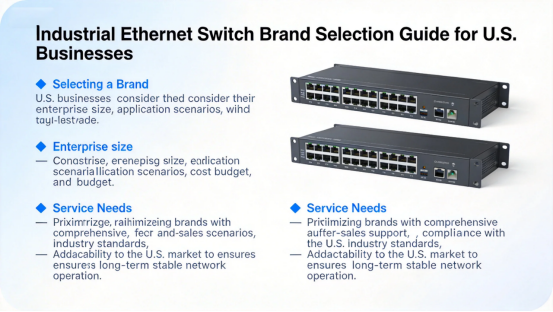
When selecting a brand, U.S. businesses should consider their enterprise size, application scenarios, cost budget, and service needs—prioritizing brands with comprehensive after-sales support, compliance with U.S. industry standards, and adaptability to the U.S. market to ensure long-term stable network operation.
6. Applications of Industrial Ethernet Switches in Key U.S. Industries: Real Case Studies
As the core component of industrial networks, industrial Ethernet switches have been widely adopted in key U.S. industries, helping enterprises drive digital transformation, improve operational efficiency, and reduce production risks. The following real U.S. case studies illustrate the application value of industrial Ethernet switches across different sectors:
Manufacturing and Industrial Automation: General Motors Smart Factory in Detroit
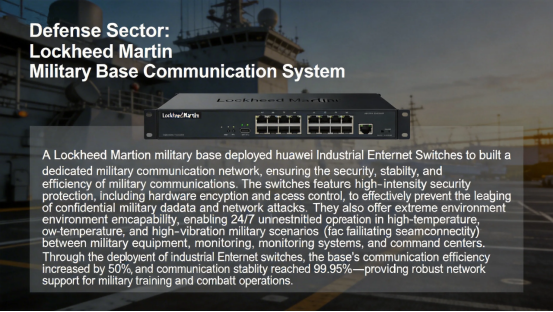
General Motors’ smart factory in Detroit serves as a benchmark for Industry 4.0 in the U.S. The facility deployed Hirschmann managed industrial Ethernet switches to build an enterprise-wide industrial network, enabling seamless connectivity between robots, PLCs, sensors, and monitoring equipment. Through VLAN segmentation, industrial Ethernet switches separate production, monitoring, and management data streams, ensuring the real-time performance and security of production data. Additionally, ring network redundancy technology prevents production shutdowns caused by single-point failures. Post-deployment, the factory’s production efficiency increased by 25%, and network failure rates dropped by 90%—significantly reducing losses from production interruptions and enabling intelligent control of the production process.
Energy Industry: Wind Farm in Texas
Texas is a core hub for wind power generation in the U.S. A large wind farm in the state deployed Huawei PoE industrial Ethernet switches to address the network transmission and power supply challenges of outdoor wind turbines. Each turbine is equipped with sensors and monitoring equipment, and industrial Ethernet switches transmit both data and power to these devices via Ethernet cables—eliminating the need for separate power lines and greatly simplifying outdoor wiring. The switches also offer wide temperature adaptability and EMI resistance, ensuring stable operation in extreme outdoor temperatures and strong electromagnetic environments, real-time transmission of turbine operating data (rotational speed, power, temperature, etc.), and remote monitoring with fault early warning. Post-deployment, the farm’s operational and maintenance costs decreased by 30%, and equipment failure rates fell by 28%—improving the stability and efficiency of wind power generation.
Healthcare Industry: NewYork-Presbyterian Hospital
NewYork-Presbyterian Hospital is a leading comprehensive hospital in the U.S. To ensure the stable operation of medical equipment and secure transmission of medical data, the hospital deployed Advantech industrial Ethernet switches to build a dedicated healthcare industrial network. This network connects the hospital’s MRI machines, CT scanners, patient monitoring equipment, pharmacy management systems, and other devices. Industrial Ethernet switches support healthcare-specific protocols, ensuring the real-time transmission and confidentiality of medical data. They also feature anti-interference capabilities to prevent signal disruption between medical equipment, ensuring accurate diagnosis and treatment. Additionally, PoE industrial Ethernet switches provide integrated power and data transmission for the hospital’s IP cameras and wireless APs, simplifying network wiring and maintenance. Post-deployment, the operational stability of the hospital’s medical equipment improved by 95%, and medical data transmission efficiency increased by 40%—delivering more efficient, secure healthcare services to patients.
Transportation: California High-Speed Rail Control System
California High-Speed Rail is a critical transportation infrastructure in the U.S. Its control system deployed Hirschmann industrial Ethernet switches to build a highly reliable, secure industrial network, enabling connectivity between train dispatching, track monitoring, signal control, and other equipment. The switches offer strong vibration and EMI resistance, ensuring stable operation in the complex environment of high-speed train operations. Redundancy backup technology guarantees real-time transmission of train dispatching data, preventing train delays or safety accidents caused by network interruptions. Additionally, the switches support remote management, allowing operational personnel to monitor network status in real time and diagnose faults promptly—ensuring the safe, efficient operation of California High-Speed Rail. The successful deployment of this project provides reliable network support for the intelligent upgrading of U.S. high-speed rail.
Defense Sector: Lockheed Martin Military Base Communication System
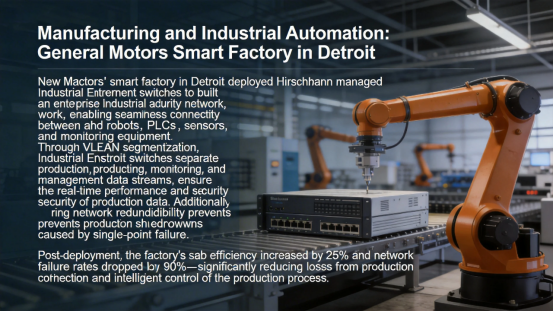
A Lockheed Martin military base deployed Huawei industrial Ethernet switches to build a dedicated military communication network, ensuring the security, stability, and efficiency of military communications. The switches feature high-intensity security protection, including hardware encryption and access control, to effectively prevent the leakage of confidential military data and network attacks. They also offer extreme environment adaptability, enabling 24/7 uninterrupted operation in high-temperature, low-temperature, and high-vibration military scenarios—facilitating seamless connectivity between military equipment, monitoring systems, and command centers. Through the deployment of industrial Ethernet switches, the base’s communication efficiency increased by 50%, and communication stability reached 99.99%—providing robust network support for military training and combat operations.
7. How to Choose the Right Industrial Ethernet Switch? Key Evaluation Factors
Selecting an industrial Ethernet switch requires U.S. businesses to comprehensively evaluate a product’s performance, functionality, environmental adaptability, and other factors based on the unique needs of their industrial scenarios—avoiding blind selection that leads to unstable networks and unnecessary costs. Below are the key evaluation factors for choosing an industrial Ethernet switch:
1. Environmental Adaptability Evaluation
- Temperature Range: Select a wide-temperature industrial Ethernet switch that matches the minimum and maximum temperatures of the industrial environment to ensure stable operation in extreme conditions.
- Protection Level: Choose an appropriate IP protection level (e.g., IP65, IP67) based on the dust and humidity conditions of the scenario to prevent dust and moisture from damaging the device.
- Anti-Interference Capability: For environments with strong electromagnetic interference (e.g., U.S. factories, military bases), select switches with robust anti-EMI capabilities to avoid data transmission issues caused by signal interference.
2. Performance and Function Requirement Evaluation
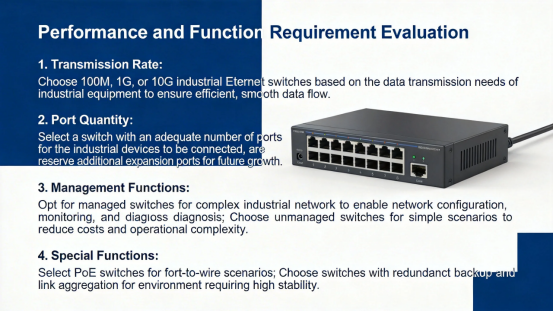
- Transmission Rate: Choose 100M, 1G, or 10G industrial Ethernet switches based on the data transmission needs of industrial equipment to ensure efficient, smooth data flow.
- Port Quantity: Select a switch with an adequate number of ports for the industrial devices to be connected, while reserving additional expansion ports for future growth.
- Management Functions: Opt for managed switches for complex industrial networks to enable network configuration, monitoring, and fault diagnosis; choose unmanaged switches for simple scenarios to reduce costs and operational complexity.
- Special Functions: Select PoE switches for hard-to-wire scenarios; choose switches with redundancy backup and link aggregation for environments requiring high stability.
3. Compatibility and Compliance Evaluation
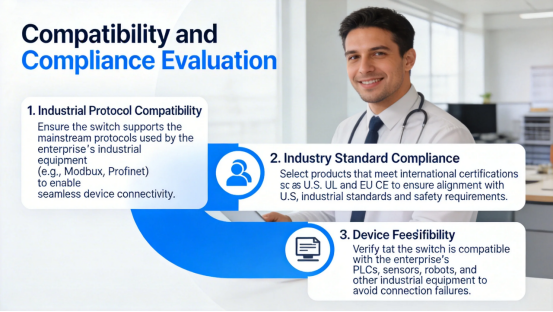
- Industrial Protocol Compatibility: Ensure the switch supports the mainstream protocols used by the enterprise’s industrial equipment (e.g., Modbus, Profinet) to enable seamless device connectivity.
- Industry Standard Compliance: Select products that meet international certifications such as U.S. UL and EU CE to ensure alignment with U.S. industrial standards and safety requirements.
- Device Compatibility: Verify that the switch is compatible with the enterprise’s PLCs, sensors, robots, and other industrial equipment to avoid connection failures.
4. Brand and After-Sales Service Evaluation
- Brand Reputation: Choose brands with a strong market reputation and technical expertise to ensure product quality and long-term stability.
- After-Sales Service: Select brands with a comprehensive service network in the U.S. to ensure timely access to technical support, maintenance, and firmware updates in the event of faults.
- Product Lifecycle: Opt for switches with a long product lifecycle to align with the long-term deployment needs of industrial equipment and avoid costs associated with frequent device replacement.
By comprehensively evaluating these factors, U.S. businesses can select industrial Ethernet switches that not only meet their current needs but also support long-term enterprise growth—providing a solid foundation for industrial network construction.
8. Future Trends of Industrial Ethernet Switches: Empowering the Intelligent Upgrade of Industrial Networks
As industrial digitalization and intelligent transformation continue to advance, industrial Ethernet switches are constantly evolving. Integrated with emerging technologies such as IoT, AI, and 5G, they are poised to follow these key trends—further empowering the intelligent upgrade of U.S. industrial networks:
1. In-Depth Integration of 5G and Industrial Ethernet Switches
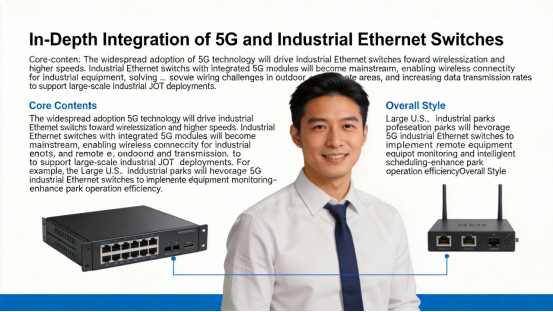
The widespread adoption of 5G technology will drive industrial Ethernet switches toward wirelessization and higher speeds. Industrial Ethernet switches with integrated 5G modules will become mainstream, enabling wireless connectivity for industrial equipment, solving wiring challenges in outdoor and remote areas, and increasing data transmission rates to support large-scale industrial IoT deployments. For example, large U.S. industrial parks will leverage 5G industrial Ethernet switches to implement remote equipment monitoring and intelligent scheduling—enhancing park operational efficiency.
2. AI-Powered Intelligent Monitoring and Fault Early Warning
Future industrial Ethernet switches will integrate AI capabilities to enable real-time monitoring of network status and equipment operation. Through data analysis, they will proactively alert users to potential network faults and equipment abnormalities—reducing fault diagnosis time and improving network management efficiency. For instance, industrial Ethernet switches in U.S. smart factories will use AI algorithms to identify network congestion, port failures, and other issues, automatically adjusting network parameters to maintain stable operation.
3. Enhanced Security Protection Capabilities
As industrial network attacks become more frequent, the security performance of industrial Ethernet switches will continue to improve. They will integrate advanced security features such as hardware encryption, intrusion detection, and access control—building a comprehensive industrial network security framework to ensure the confidentiality, integrity, and availability of industrial data, while meeting strict U.S. industrial network security requirements.
4. Modular and Customized Upgrades
U.S. enterprises’ demand for personalized industrial Ethernet switches will continue to grow. Modular design will become standard, allowing businesses to flexibly select port modules and function modules for customized deployment. These switches will also support future module upgrades—reducing enterprise investment costs and adapting to the dynamic changes of industrial scenarios.
5. In-Depth Integration with the Industrial Internet of Things (IIoT)
Industrial Ethernet switches will serve as the core connectivity devices for the IIoT, integrating closely with IoT platforms and intelligent terminals to enable end-to-end industrial data collection, transmission, analysis, and application. This will help U.S. enterprises achieve equipment intelligence and production intelligence—driving the further development of industrial digital transformation.
9. Conclusion: Invest in Industrial Ethernet Switches to Lay the Foundation for Industrial Digital Transformation
In the wave of industrial digital transformation, industrial Ethernet switches—as the core component of industrial networks—are becoming increasingly critical. Whether in manufacturing, energy, healthcare, transportation, or defense, industrial Ethernet switches provide robust support for industrial equipment connectivity, data transmission, and network stability—making them a key investment for U.S. enterprises looking to achieve intelligent upgrading, improve operational efficiency, and reduce production risks.
When selecting industrial Ethernet switches, U.S. enterprises should discard the misconception that “commercial switches can be substituted.” Instead, they should comprehensively evaluate a product’s environmental adaptability, performance, compatibility, and brand services based on their specific scenario needs—selecting the right products and brands. For U.S. businesses, priority should be given to brands that comply with U.S. industry standards and offer comprehensive local support to ensure long-term stable network operation.
With the integration of emerging technologies such as 5G, AI, and IoT, industrial Ethernet switches will undergo further upgrades—becoming more intelligent, secure, and flexible—providing even stronger network support for industrial digital transformation. Investing in industrial Ethernet switches is not only the foundation for building industrial networks but also a strategic move for U.S. enterprises to seize opportunities in industrial intelligence and achieve long-term growth—and now is the ideal time to deploy.