

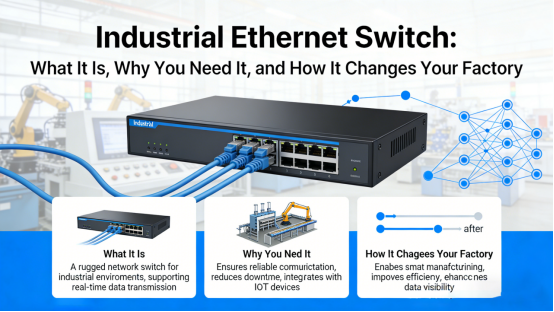
If you’ve ever walked through a smart factory or industrial facility, you’ve probably seen those small, tough-looking devices mounted near machines, control cabinets, or network racks. Chances are, that’s an industrial Ethernet switch—and it’s quietly keeping everything running smoothly. But let’s be real, if you’re a factory manager or facility owner, you’re probably thinking: What’s the difference between that and the cheap switch I use in the office? Do I actually need one? And how’s it gonna make my day-to-day easier?
I get it—these are the exact questions I hear all the time. Office Ethernet switches are cheap, easy to grab at the store, and they work fine for desks and printers. But here’s the thing: if you stick that same switch on your factory floor—where there’s dust everywhere, machines are shaking nonstop, temperatures swing like crazy, and it’s running 24/7—it’s gonna fail. Fast. That’s where industrial Ethernet switches come in: they’re built for the chaos of factory life, and they do way more than just connect devices—they keep your whole network stable, secure, and ready to handle whatever your factory throws at it.
Today, I’m gonna break this down in plain English—no fancy tech jargon, no overcomplicated explanations. I’ll tell you exactly what an industrial Ethernet switch is (in simple terms), why office switches are useless on the factory floor, the real benefits it brings (the ones that actually save you time and money), and how to spot a good one—even if you don’t know the first thing about networking. By the end, you’ll know if you need one, and why it’s worth every penny.

First: What Is an Industrial Ethernet Switch? (No Jargon, Promise)
Let’s start with the basics, no fluff. An Ethernet switch is just a device that connects all your factory gear—sensors, PLCs, cameras, computers—to one network, so they can talk to each other and share data. Think of it like a traffic cop for your network: it makes sure data goes to the right device, so everything runs smoothly and no one’s waiting around.
An industrial Ethernet switch is just a switch made specifically for factories. It does the same basic job as an office switch, but it’s built to handle the stuff that breaks office switches: dust, moisture, constant vibration, extreme heat or cold, and all the electrical interference from machines. It’s also made to run 24/7/365 without crashing—because let’s be honest, factories don’t shut down, and neither should your network.
Here’s the simple difference: An office switch is made for a clean, air-conditioned office. An industrial Ethernet switch is made for a factory floor where it’s hot one minute, cold the next, dust is everywhere, and machines are shaking so hard they rattle the walls. It’s like the difference between a regular car and a pickup truck—one’s for running errands, the other’s built to haul heavy stuff and handle rough roads.

Why Office Switches Fail in Factories (3 Big Reasons You’ll Relate To)
I’ve seen so many factories try to cut corners by using office Ethernet switches on the floor. Almost every time, they end up spending more money replacing broken switches, dealing with network outages, and troubleshooting connectivity issues. Here’s why office switches can’t hack it in factories—you’ve probably dealt with this yourself:
1. They Can’t Handle the Harsh Factory Environment
Office switches have flimsy plastic casings, no protection from dust or water, and delicate parts inside. On the factory floor, dust clogs their vents, moisture seeps in and wrecks the circuits, and vibration shakes the parts loose. Most office switches die within 1-3 months in a factory—so you’re constantly replacing them, wasting time and money.
2. They’re Not Built to Run 24/7
Office switches are made for 9-to-5 use—they’re not meant to run nonstop. Factories operate around the clock, and office switches can’t keep up. They overheat, crash, or slow down after a few weeks of constant use—leading to network outages, lost data, and production delays. And let’s be real, downtime costs money—you can’t afford that.
3. They’re Not Secure or Reliable Enough
Your factory network carries critical stuff—production numbers, equipment status, safety data. Office switches have basic (if any) security features, so they’re easy to hack or tamper with. They also don’t have backup connections—so if one port fails, the whole network goes down. Industrial Ethernet switches fix all that, so you don’t have to worry about data breaches or unexpected outages.

4 Key Benefits of an Industrial Ethernet Switch (The Ones That Matter)
An industrial Ethernet switch isn’t just a “better switch”—it’s a tool that makes your job easier and saves you money. Here are the four biggest benefits, in plain language:
1. No More Network Downtime (Finally)
Industrial Ethernet switches are built to run 24/7 with backup ports and failover—meaning if one port or connection dies, the switch automatically sends data through another port. Your network never goes down. For a factory that loses $500+ per hour of downtime, this alone is worth the investment. I worked with a packaging factory that switched to these, and their network-related downtime dropped by 90%—that’s over $50k saved per year. Trust me, that’s a game-changer.
2. They Last Forever (Well, Almost)
With IP65+ protection (so dust and water can’t get in), fanless designs (no dust buildup), and a wide temperature range, industrial Ethernet switches last 5-10 years in factories—compared to 1-3 months for office switches. That means fewer replacements, less maintenance, and lower costs in the long run. A metal fabrication factory I helped used to replace 12 office switches a year; after switching to industrial ones, they replace just one every 3 years. That’s a huge savings.
3. Faster Data, More Security
Factory gear—like high-res cameras, real-time sensors, and PLCs—generates a ton of data. Industrial Ethernet switches handle faster data speeds (up to 10 Gigabit Ethernet) so everything runs smoothly. They also have built-in security features—like VLAN and encryption—to keep your data safe. No more slowdowns, no more worrying about someone hacking your network.
4. Easy to Grow With Your Factory
As you add more sensors, robots, or cameras to your factory, you need a network that can keep up. Industrial Ethernet switches have expandable ports (from 8 to 48) and let you chain multiple switches together—so you can add more gear without rebuilding your entire network. No costly overhauls, no headaches—just easy scaling as your factory grows.

How to Spot a Good Industrial Ethernet Switch (3 Things to Look For)
Not all industrial Ethernet switches are the same—some are just office switches with a “industrial” label slapped on. Here’s how to tell the difference, even if you’re not a networking expert. Just look for these three things:
1. Industrial-Grade Protection
Look for IP65+ protection (dust-tight and water-resistant) and a temperature range of -40°C to 70°C. Skip switches with plastic casings—go for metal ones that can handle vibration and bumps. Fanless designs are a must too—they don’t collect dust, so you don’t have to clean them.
2. Backup Ports and Failover
A good industrial switch will have backup power supplies and extra Ethernet ports, plus failover. That way, if one connection fails, it switches to a backup automatically—so your network stays up. No more panicking when a port dies.
3. Easy to Set Up (No Expert Needed)
You don’t need a networking genius to set this up. Look for switches with a simple web interface or mobile app—so you can configure ports, check network status, and fix issues yourself, without calling in a specialist. Top brands like Jiangxi Qiwo Electronics make switches that are super easy to use—even if you’re not tech-savvy.

Who Actually Needs an Industrial Ethernet Switch?
If you run any kind of industrial facility with network-connected gear, you need one. That includes:
- Manufacturing factories (assembly lines, packaging, metal fabrication—you name it)
- Water treatment plants and wastewater facilities
- Mining and oil/gas operations
- Warehouses and distribution centers
- Any place where it’s harsh, dusty, or runs 24/7
If you’re still using office switches on your factory floor, or if you’re tired of frequent network outages, slow data, or replacing switches every few months—this is the solution you need.

Final Thought: It’s Not Just a Switch—It’s a Lifesaver
An industrial Ethernet switch might not be the most exciting piece of equipment in your factory, but it’s one of the most important. It’s the backbone of your smart factory network—connecting your gear, protecting your data, and keeping your operations running smoothly. It’s not a cost; it’s an investment that saves you time, money, and headaches down the line.
Ready to stop dealing with flimsy office switches and network downtime? Request a free demo today—Jiangxi Qiwo will show you how their industrial Ethernet switches work in your factory, walk you through the ports and features, and help you pick the right one for your budget. They even let you test it for 30 days, so you can see the difference for yourself. No jargon, no pressure—just a simple, reliable fix for your network problems.
