

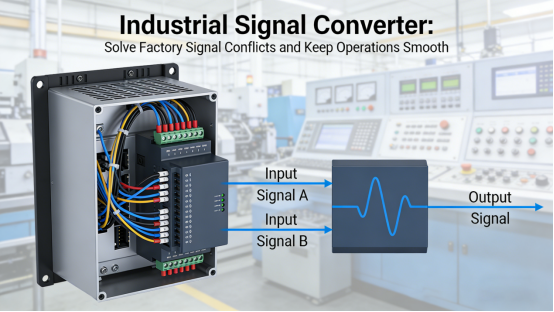
Smart factories are growing fast—but there’s a hidden problem many managers overlook: signal conflicts. Your sensors send analog signals, your PLCs use digital signals, and your control system needs a uniform signal to work. The result? Mismatched signals, inaccurate data, and unexpected downtime. But here’s the good news: You don’t have to let signal chaos slow you down—an industrial signal converter is your quick, easy fix.
If you’re new to signal converters, don’t worry—this isn’t complicated. Today, we’re keeping it light, straightforward, and actionable. No confusing tech jargon, no over-the-top jargon—just the basics you need to know to fix signal conflicts, keep your equipment talking, and boost your factory’s efficiency. Let’s dive in!

What Even Is an Industrial Signal Converter? (1-Minute Breakdown)
Let’s keep this simple: An industrial signal converter is a compact, tough device that “translates” one type of industrial signal into another. Think of it as a bilingual translator for your factory equipment—when your sensor speaks “analog” and your PLC speaks “digital,” the converter steps in to make sure they understand each other.
Here’s the key: Factories use two main types of signals—analog (continuous signals, like temperature or pressure readings) and digital (on/off signals, like a machine being active or idle). Most equipment only “speaks” one type, so when you mix them, you get miscommunication. The industrial signal converter fixes that by converting analog to digital, digital to analog, or even different types of analog/digital signals—so all your equipment works together seamlessly.
It’s small, easy to install, and built for factory life—no fancy setup, no complicated programming. Just plug it in, configure it in minutes, and let it do the work.

Why Signal Conflicts Are Costing You Time and Money (And You Don’t Even Know It)
Signal conflicts might seem like a small issue, but they’re quietly eating into your profits. Here are the three most common ways signal mismatches hurt your factory—and how a signal converter fixes them, fast:
1. Inaccurate Data = Bad Decisions
When signals are mismatched, your control system gets wrong data. For example, a sensor sends an analog temperature reading, but your PLC can’t read it—so it shows the wrong temperature. You might think a machine is running fine when it’s overheating, leading to breakdowns and costly downtime. A signal converter ensures the data is translated correctly, so you get accurate readings every time.
2. Equipment Mismatches = Wasted Investments
You don’t need to replace all your equipment to fix signal issues. If you have old analog sensors but a new digital control system, a signal converter lets them work together—saving you thousands of dollars on new equipment. No more replacing perfectly good sensors or PLCs—just add a converter and keep going.
3. Constant Troubleshooting = Wasted Time
Technicians spend hours troubleshooting signal conflicts—checking cables, reconfiguring equipment, and trying to fix miscommunication. A signal converter eliminates this hassle by ensuring signals are translated correctly from the start. No more wasted time, no more frustration—just smooth, seamless communication between your equipment.

3 Real-World Factory Scenarios Where a Signal Converter Saves the Day
Signal converters aren’t just a “nice-to-have”—they’re a lifesaver in real factories. Here are three common scenarios where they fix problems and boost efficiency:
Scenario 1: Old Analog Sensors + New Digital PLC
A food processing plant had 15 old analog temperature sensors that still worked great—but they upgraded to a new digital PLC that couldn’t read analog signals. Instead of replacing the sensors (which would cost $5,000), they installed 3 industrial signal converters to translate analog to digital. Now, the sensors and PLC work together perfectly, and they saved thousands of dollars.
Scenario 2: Remote Sensors with Weak Signals
A mining operation had remote sensors that sent weak analog signals—they kept dropping out, leading to inaccurate data. They added industrial signal converters that not only translated the signal but also boosted its strength. Now, the sensors send reliable data to the control room, even from remote locations, cutting downtime by 40%.
Scenario 3: Mixed Signal Types in Assembly Lines
A car manufacturing plant had an assembly line with mixed equipment—some sensors sent 4-20mA analog signals, others sent 0-10V analog signals, and the PLC needed digital signals. They installed a single signal converter that handled all the translation, unifying the signals and making the assembly line run smoother. They cut troubleshooting time by 60% and improved production speed by 15%.

How to Pick the Right Industrial Signal Converter (3 Easy Tips)
Picking a signal converter doesn’t have to be hard. Just follow these three tips, and you’ll get the perfect one for your factory—no tech expertise required:
Tip 1: Know What Signal Types You Need to Convert
First, figure out what signals your equipment uses. Do you need to convert analog to digital (A/D), digital to analog (D/A), or analog to analog (e.g., 4-20mA to 0-10V)? Pick a converter that supports the specific signal types you need—this ensures it works with your existing equipment.
Tip 2: Prioritize Industrial-Grade Durability
Like all factory equipment, your signal converter needs to be tough. Look for IP65+ dust and water protection, a wide temperature range (-40°C to 70°C), and vibration resistance. It should handle the dust, moisture, and vibration of factory life—no exceptions.
Tip 3: Choose Easy Configuration
You don’t need a tech expert to set up your converter. Look for models with a simple web interface or dip switches—so you can configure it in minutes, without calling in a specialist. Top brands like Jiangxi Qiwo Electronics make signal converters that are plug-and-play, so you can get up and running fast.

Why an Industrial Signal Converter Is a Must-Have for Smart Factories
Smart factories rely on seamless communication between equipment—and that means no signal conflicts. An industrial signal converter is a small investment that delivers big returns: it saves you money on equipment replacements, cuts troubleshooting time, ensures accurate data, and keeps your operations running smoothly.
It’s not just a tool—it’s the glue that holds your smart factory together. Whether you’re upgrading equipment, dealing with old sensors, or just tired of signal conflicts, a signal converter is the simple, effective solution.

Who Needs an Industrial Signal Converter?
If you’re dealing with any of these, you need a signal converter:
- You have mixed analog/digital equipment (sensors, PLCs, control systems).
- You’re upgrading your control system but want to keep old sensors.
- You have weak or unstable signals from remote sensors.
- You’re tired of troubleshooting signal conflicts and inaccurate data.
- You want to save money on equipment replacements.
This includes manufacturing plants, food processing facilities, mining operations, water treatment plants, and any industrial facility with mixed signal equipment. If you want to keep your factory running smoothly, a signal converter is a must.

Final Thought: Signal Harmony = Smooth Operations
Signal conflicts don’t have to be a headache. An industrial signal converter is a simple, affordable tool that fixes miscommunication between your equipment, ensures accurate data, and saves you time and money. It’s the small device that makes a big difference in your factory’s efficiency.
Ready to solve signal conflicts and keep your operations smooth? Request a free demo today from Jiangxi Qiwo Electronics. They’ll show you how their industrial signal converters work with your equipment, help you pick the right model, and even let you test it for 30 days. No jargon, no pressure—just a simple solution to your signal headaches.
