

In the era of smart factories, seamless connectivity between equipment is no longer a luxury—it’s a necessity. Yet for many factory managers, engineers, and even seasoned industrial professionals, one term often sparks confusion: industrial protocol gateway. You may have heard it mentioned in discussions about factory automation, data integration, or smart upgrades, but what exactly is an industrial protocol gateway, and why does it matter for your factory’s efficiency and profitability? This guide breaks down everything you need to know, in plain language, with no confusing tech jargon—so you can understand its purpose, how it works, and why it’s a critical component of modern industrial operations. Whether you’re new to industrial connectivity or looking to expand your knowledge, this科普 will demystify the industrial protocol gateway and show you how it solves one of the most common pain points in today’s factories: incompatible equipment and disconnected data.
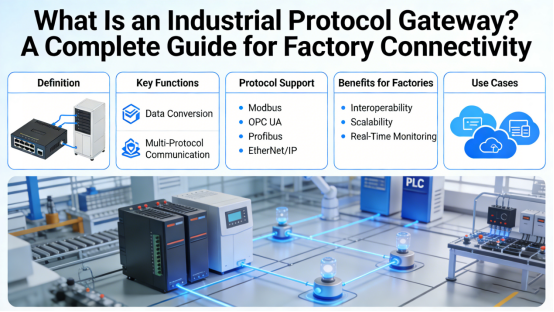
To start, let’s clarify the basics: an industrial protocol gateway is a specialized device designed to bridge the gap between different industrial communication protocols, allowing diverse factory equipment to “talk” to each other seamlessly. If you’ve ever struggled with a scenario where your new PLC, old sensors, and cloud-based control system can’t communicate—each speaking a different “language”—you’ve encountered the problem that an industrial protocol gateway is built to solve. Industrial equipment relies on a variety of communication protocols—such as Modbus, RS-485, Ethernet/IP, and Profinet—and most devices are only designed to support one or two of these protocols. This incompatibility creates data silos, where critical information is trapped in individual devices, forcing teams to manually transfer data, troubleshoot constant conflicts, and make decisions based on incomplete or outdated information. The industrial protocol gateway acts as a universal translator, converting these different protocols into a uniform format that all your equipment can understand, enabling bidirectional communication and unlocking the full potential of your factory’s data.

Unlike consumer-grade connectivity devices, an industrial protocol gateway is built to withstand the harsh conditions of factory environments—from extreme temperatures and heavy vibration to dust, moisture, and electrical interference. This durability is key, as factory equipment operates 24/7, and any downtime from a failed gateway can lead to costly production delays. But beyond durability, the true value of an industrial protocol gateway lies in its ability to simplify connectivity without requiring a complete overhaul of your existing equipment. Many factories assume that solving protocol incompatibility means replacing old, functional sensors or controllers, which can cost thousands of dollars. However, a high-quality industrial protocol gateway lets you keep your current equipment, saving you money while still enabling the seamless data flow needed for a smart factory. It’s a cost-effective solution that bridges the gap between legacy equipment and modern automation systems, making it easier to transition to a more efficient, data-driven operation.
To understand how an industrial protocol gateway works in practice, consider a typical scenario in a mid-sized manufacturing plant. Imagine a facility that has been operating for a decade, with a mix of older analog sensors (using RS-485 protocol) and newer digital PLCs (using Modbus TCP protocol). For years, technicians have spent hours each day manually logging data from the sensors into the PLC system, a process that is not only time-consuming but also prone to human error. When the plant decides to upgrade to a cloud-based SCADA system (which uses Ethernet/IP protocol), they realize none of their existing equipment can communicate with the new system—creating a roadblock to their smart factory goals. By installing an industrial protocol gateway, the plant is able to convert the RS-485 signals from the old sensors to Modbus TCP, and then to Ethernet/IP for the SCADA system. Suddenly, all equipment is connected: sensors send real-time data to the PLC, which shares insights with the SCADA system, and plant managers can access accurate, up-to-date information from anywhere. This not only eliminates manual data entry and reduces errors but also allows the plant to identify inefficiencies, predict equipment failures, and optimize production—all thanks to the seamless connectivity enabled by the industrial protocol gateway.

Another common misconception about industrial protocol gateways is that they are complex to set up and maintain, requiring specialized technical expertise. In reality, modern industrial protocol gateways are designed with user-friendliness in mind, featuring intuitive web interfaces or mobile apps that allow even non-technical staff to configure protocols, monitor connectivity, and troubleshoot minor issues. Top models, such as those from Jiangxi Qiwo Electronics, support a wide range of common industrial protocols, making them versatile enough to work with almost any factory setup. They also offer features like real-time data monitoring, error alerts, and remote access, so you can keep an eye on your connectivity status and address any issues before they impact production. This ease of use means that even small to mid-sized factories, without dedicated IT teams, can benefit from the connectivity and efficiency gains of an industrial protocol gateway.

As factories continue to embrace smart automation, the role of the industrial protocol gateway will only grow in importance. Data is the lifeblood of a smart factory, and without seamless connectivity, that data is useless. An industrial protocol gateway ensures that your equipment can communicate effectively, unlocking real-time insights that drive better decision-making, reduce downtime, and boost productivity. It’s not just a “nice-to-have” device—it’s a foundational component that enables factories to compete in an increasingly automated world. Whether you’re looking to integrate legacy equipment with new systems, eliminate data silos, or simply make your operations more efficient, understanding the industrial protocol gateway is the first step toward building a smarter, more connected factory.

For those looking to implement an industrial protocol gateway in their facility, the key is to choose a model that aligns with your specific needs. Look for a gateway that supports all the protocols used by your equipment, offers industrial-grade durability (such as IP65+ protection and a wide temperature range), and is easy to configure and maintain. By selecting the right industrial protocol gateway, you can avoid the common pitfalls of incompatible equipment, reduce labor costs associated with manual data transfer, and unlock the full potential of your factory’s data. With the right guidance and the right device, you can transform your factory’s connectivity and take a significant step toward becoming a truly smart, efficient operation.

In summary, the industrial protocol gateway is a simple yet powerful solution to one of the biggest challenges in modern industrial operations: protocol incompatibility. By acting as a universal translator for your factory equipment, it enables seamless communication, eliminates data silos, and helps you make the most of your existing technology. Whether you’re new to industrial connectivity or a seasoned professional, understanding how an industrial protocol gateway works and how it can benefit your facility is essential for staying competitive in the age of smart factories. With this guide, you now have the knowledge to make informed decisions about implementing an industrial protocol gateway and unlocking the full potential of your factory’s connectivity.
