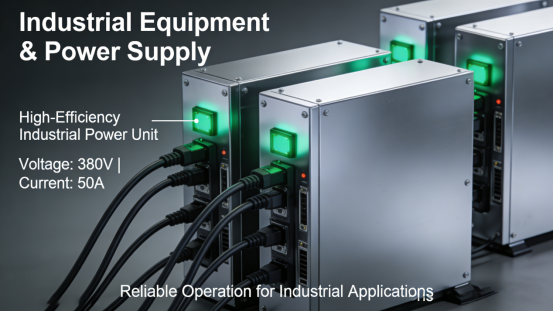

For industrial equipment engineers, maintenance teams, and purchasers, the industrial power supply is the “heart” of all industrial systems—and it’s often overlooked until it fails. Unexpected power supply breakdowns trigger equipment shutdowns, production halts, component damage, and costly downtime—issues easily avoided with the right selection and use of an industrial power supply.
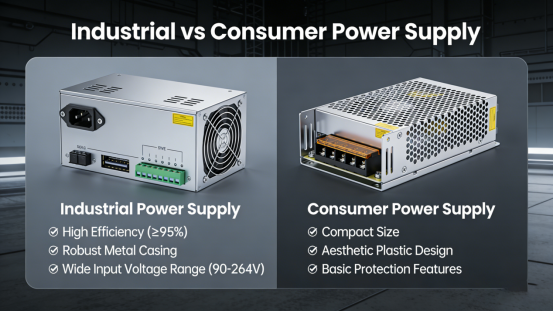
Unlike consumer-grade power supplies (designed for home or office use), industrial power supplies must withstand harsh industrial conditions: voltage fluctuations, electromagnetic interference, dust, vibration, and extreme temperatures. A reliable industrial power supply isn’t just a “power source”—it’s a critical guarantee for the stable operation of industrial equipment like control systems, sensors, automated production lines, and HMIs.
This article provides objective, fact-based guidance aligned with official product manuals and industrial technical standards. We’ll cover industrial power supply core functions, key selection criteria, and common mistakes to avoid—no marketing jargon, no sales pitches, no exaggerated claims, just actionable tips to help you choose a durable, stable industrial power supply that cuts failures and saves costs.
What Makes an Industrial Power Supply Different from Consumer-Grade Ones?
An industrial power supply is a specialized power conversion device engineered to deliver stable, reliable power for industrial equipment. Unlike consumer-grade models (which prioritize cost and size), industrial power supplies focus on durability, anti-interference, and long-term stability—features tailored to harsh industrial site conditions.
The core advantages of industrial power supplies (per product manual specs) include:
- Wide input voltage range: Adapts to unstable industrial power grids, avoiding failures caused by voltage fluctuations.
- Strong anti-interference capability: Resists electromagnetic interference from motors, frequency converters, and other industrial equipment.
- Robust environmental adaptability: Withstands dust, vibration, and extreme temperatures common in industrial workshops.
- Multiple protection functions: Prevents damage to the power supply and connected equipment from over-voltage, over-current, short-circuit, and over-temperature.
- Long service life: Designed for 24/7 continuous operation, meeting the long-term working needs of industrial equipment.
For industrial systems, a low-quality power supply is a hidden risk—choosing the right industrial power supply is the first step to ensuring stable equipment operation.
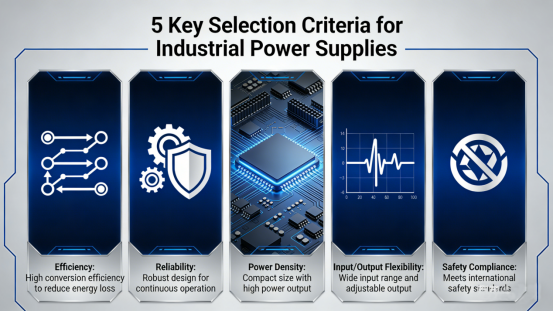
5 Core Selection Criteria (From Official Product Manuals)
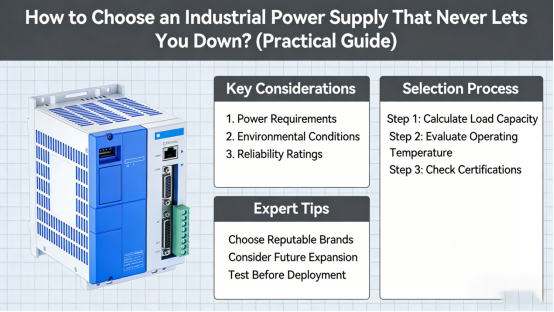
To choose an industrial power supply that meets your equipment’s needs and avoids costly failures, focus on these five core criteria—all verified by official product manuals and industrial technical standards:
1. Input Voltage Range Compatibility
Industrial power grids are often unstable, with voltage fluctuations that damage consumer-grade power supplies. A reliable industrial power supply should support a wide input voltage range (per product manual specs)—typically 85-264V AC for AC-DC models, or 12-36V DC for DC-DC units.
This wide range ensures stable operation even when grid voltage drops or spikes, preventing unexpected shutdowns and equipment damage.
2. Output Stability & Accuracy
Industrial equipment (e.g., sensors, control systems) requires precise, stable power to function correctly. Look for an industrial power supply with output voltage accuracy of ≤±1% (per product manual) to ensure consistent power delivery.
Low ripple and noise (≤120mVp-p) are also critical—excessive ripple interferes with signal transmission and damages sensitive components like sensors and microcontrollers.
3. Protection Functions (Non-Negotiable)
Industrial power supplies need comprehensive protection to safeguard both the unit and connected equipment. Per product manual guidelines, prioritize these protection functions:
- Over-voltage protection (OVP): Shuts down the power supply if output voltage exceeds safe limits, protecting connected equipment.
- Over-current protection (OCP): Limits output current to prevent overheating and damage to the power supply and equipment.
- Short-circuit protection (SCP): Instantly cuts power in case of a short circuit, avoiding fire or permanent damage.
- Over-temperature protection (OTP): Shuts down the power supply if it overheats, extending its service life.
4. Environmental Adaptability
Industrial power supplies are installed in harsh environments, so environmental adaptability is key. Per product manual specs, look for these features:
- Operating temperature range: -20°C to 70°C, adapting to extreme cold and heat in industrial workshops.
- Protection rating: IP20 or higher for cabinet-mounted models; IP65 or higher for on-site installation (dust and moisture resistance).
- Vibration resistance: 10-500Hz, matching the vibration of industrial machinery.
5. Service Life & Reliability
Industrial equipment operates 24/7, so your power supply must too. Choose an industrial power supply with a service life of ≥50,000 hours (continuous operation, per product manual) and a mean time between failures (MTBF) of ≥100,000 hours.
This reliability reduces replacement frequency and unplanned downtime, cutting long-term costs.
4 Common Mistakes to Avoid (Save Time & Money)
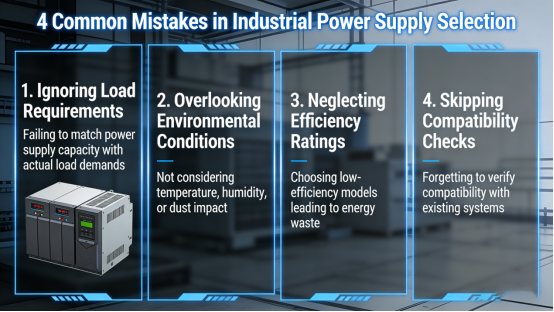
Based on real industrial experience, these four mistakes often cause power supply failures and costly losses. Avoid them to make the right choice:
Mistake 1: Choosing Consumer-Grade Power Supplies for Industrial Use
Consumer-grade power supplies lack the anti-interference, protection, and environmental adaptability needed for industrial use. They may work temporarily but fail quickly, leading to production halts and replacement costs.
Mistake 2: Ignoring Output Ripple & Noise
Excessive ripple and noise damage sensitive components like sensors and control modules—always check these specs in the product manual before purchasing.
Mistake 3: Underestimating Power Capacity
Choosing a power supply with insufficient capacity causes overheating and premature failure. Calculate your equipment’s total power consumption and select a unit with a 20-30% capacity margin (per product manual recommendations).
Mistake 4: Skipping Compatibility Checks
Ensure the power supply’s input/output voltage, current, and interface match your equipment’s needs. Incompatible units cause equipment damage and operational failures.
Conclusion: Choose Wisely to Avoid Costly Failures
Choosing a reliable industrial power supply isn’t complicated—focus on compatibility, output stability, protection functions, environmental adaptability, and service life. These criteria, aligned with official product manuals and industrial standards, ensure long-term stable service.
By avoiding common mistakes and following this selection guide, you’ll reduce power supply failures, minimize downtime, and cut maintenance costs—keeping your industrial equipment running smoothly around the clock.
This article offers objective, practical guidance for industrial professionals—no promotions, no sales pitches, just fact-based tips to help you choose an industrial power supply that never lets you down.