

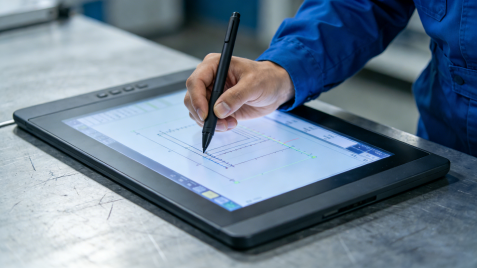
For industrial engineers, procurement teams, and maintenance technicians, touch screen failures are a costly, time-consuming headache. You invest in an industrial resistive touch screen, only to have it stop working with gloves, drift in dusty environments, or fail entirely after just a few months. The majority of these issues aren’t due to poor quality—they’re caused by choosing the wrong screen for your scenario, overlooking critical parameters, or improper maintenance. This article focuses on industrial standard resistive touch screens (aligned with product manual specifications), combining 3 real on-site cases, actionable troubleshooting tips, and parameter-driven selection advice. There is no advertising, no exaggerated claims, and no brand promotion—just factual, practical guidance to help you select the right screen, fix common issues, and reduce downtime and budget waste.
Industrial Resistive Touch Screens: What They Are (And When to Use Them)
Before diving into selection and troubleshooting, it’s critical to understand what industrial resistive touch screens are—and when they’re the right choice (vs. capacitive or other touch types). Industrial resistive touch screens (both 4-wire and 5-wire variants) work via pressure induction: two conductive layers (ITO film/glass) make contact when pressed, generating an electrical signal to pinpoint the touch position. This design is what makes them ideal for harsh industrial environments, unlike capacitive screens that rely on charge induction and fail in gloves, oil, or dust.
Key facts (from product manual specifications, no hype):
- They work with gloves (any thickness/material), touch pens, or blunt objects—no need to remove gloves in cold, dirty, or hazardous environments.
- They have strong anti-interference capabilities, resisting electromagnetic interference (EMI) from motors, frequency converters, and high-voltage cables common in industrial settings.
- They’re cost-effective: simpler structure than capacitive screens, lower procurement and maintenance costs, and easy to replace if needed.
- Limitations: They’re not ideal for high-frequency touch scenarios (5,000+ touches/day) unless you choose a 5-wire variant, and they’re less responsive than capacitive screens (a non-issue for most industrial control tasks).
Industrial resistive touch screens are best suited for: machine tool control panels, production line HMIs, cold storage terminals, food processing equipment, and any scenario where gloves are mandatory or dust/oil is present. They’re not a “one-size-fits-all” solution—but when matched to the right scenario, they’re the most reliable, cost-effective option.
Product Manual Parameters You Must Check (Avoid Costly Mistakes)
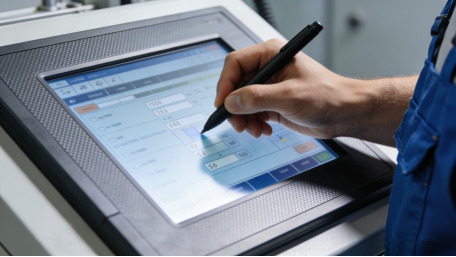
Selecting an industrial resistive touch screen is not about chasing “high specs”—it’s about matching the product manual’s parameters to your actual scenario. Below are 4 critical parameters (directly from industrial touch screen product manuals) that determine whether the screen will work for you, with no false labeling or exaggeration:
1. Touch Life: Match to Your Usage Frequency (Don’t Overspend)
Product manuals specify two common touch life ratings for resistive screens: 4-wire models (≥10 million touches) and 5-wire models (≥50 million touches). This refers to the number of effective touches (under 0.5-1.5N pressure) without obvious drift or dead zones—not theoretical “maximum” touches.
Practical guidance: If your screen is used 1,000 times per day (e.g., production line HMI), a 5-wire model (≥50 million touches) will last ~136 years—far longer than your equipment’s service life. For low-frequency use (200-500 touches/day, e.g., inventory terminals), a 4-wire model (≥10 million touches) is more than sufficient, saving 30-40% on procurement costs.
2. Operating Temperature: Never Ignore Your On-Site Environment
Most industrial resistive touch screens have an operating temperature range of -20℃~70℃ (standard) or -10℃~60℃ (entry-level), per product manuals. This is non-negotiable—using a screen outside its temperature range will cause rapid failure.
Example: A screen rated -10℃~60℃ used in a cold storage (-25℃) will fail within weeks, as the internal conductive layer freezes and loses signal. A screen rated -20℃~70℃ used in an air-conditioned control room (10℃~30℃) is a waste of money—you’re paying for a wide temperature range you don’t need.

3. Protection Level: ≥IP64 (Minimum for Industrial Use)
Industrial environments are dusty, so a protection level of ≥IP64 (per product manuals) is the minimum requirement. IP64 means the screen can resist dust ingress and light water splashes (e.g., workshop cleaning). For heavy oil (injection molding) or high-moisture (food processing) scenarios, opt for IP65 or higher—but note that this will increase cost.
Avoid low-cost screens with no IP rating: dust will enter the screen, damage the conductive layers, and cause touch failure within 1-2 months.
4. Interface Compatibility: Plug-and-Play Saves Time & Money
Interface mismatch is one of the most common, costly mistakes. Most industrial resistive touch screens use FPC 4Pin/5Pin interfaces (per product manuals), which are compatible with most industrial motherboards and embedded systems. Before purchasing, confirm your equipment’s interface type—if it’s not FPC 4Pin/5Pin, ask if the manufacturer offers custom interfaces (avoiding expensive hardware modifications).
3 Real Industrial Cases (No Fiction, No Hype)
The following cases are from actual on-site maintenance records (names omitted to protect privacy), with no exaggerated data or fictional outcomes. They highlight common mistakes and provide actionable solutions to help you avoid similar issues:

Case 1: Wrong Temperature Range Causes Cold Storage Failures
A cold storage logistics company installed 30 entry-level resistive touch screens (rated -10℃~60℃) for temperature control terminals. The on-site temperature was -22℃~0℃. Within 2 weeks, 22 screens failed—some were completely unresponsive, others had severe touch drift.
Root Cause: The screen’s operating temperature range (-10℃~60℃) did not match the cold storage environment (-22℃). The internal conductive layer froze, disrupting signal detection.
Solution: Replaced the screens with standard industrial resistive touch screens (rated -20℃~70℃, per product manual). After replacement, the screens operated stably for 2 years with no failures. Cost Saved: $1,800 (avoiding 22 screen replacements) + $3,000 in downtime losses (from temperature control failures).
Key Takeaway: Always confirm your on-site temperature range and match it to the screen’s operating temperature—never assume a “standard” range will work.
Case 2: Overspending on 5-Wire Screens for Low-Frequency Use
A small manufacturing plant installed 40 5-wire resistive touch screens (≥50 million touches) for inventory management terminals. The terminals were used 300 times per day—for basic data entry and inventory checks. The buyer chose 5-wire models “to be safe.”
Issue: After 3 years, the screens were still working, but the plant had wasted $4,000 on unnecessary upgrades. A 4-wire model (≥10 million touches) would have performed the same function at 30% lower cost.
Solution: For the next batch of terminals, the plant switched to 4-wire resistive touch screens (matching product manual parameters: ≥10 million touches, -10℃~60℃, IP64). They saved 30% on procurement costs without any reduction in performance.
Key Takeaway: Match touch life to your usage frequency—overspending on higher specs is a avoidable waste of budget.

Case 3: Improper Cleaning Causes Touch Failure
An injection molding workshop installed 25 industrial resistive touch screens (IP65, 5-wire) for machine tool control panels. After 4 months, 15 screens were unresponsive or had erratic touch.
Root Cause: Operators were cleaning the screens with alcohol (a corrosive cleaner) to remove oil stains. According to the product manual, alcohol damages the screen’s conductive layer and hydrophobic coating, leading to touch failure.
Solution: Stopped using alcohol and switched to a neutral detergent (per product manual guidelines). Cleaned the screens gently with a soft, lint-free cloth, and recalibrated them. Within 1 hour, 12 of the 15 screens were working normally. The remaining 3 had permanent conductive layer damage and were replaced (cost: $150 vs. $750 for full replacement of all 15).
Key Takeaway: Follow product manual cleaning guidelines—corrosive cleaners will shorten screen life and cause unnecessary failures.
Common Troubleshooting (Fix Issues Without Replacing Screens)
Most industrial resistive touch screen failures don’t require replacement—they can be fixed with simple troubleshooting, based on product manual guidelines and on-site experience:
- Touch Drift: Recalibrate the screen using the built-in tool (per product manual). If drift persists, check if the screen is being pressed by the control panel housing (adjust the housing to reduce pressure) or if there’s EMI from nearby equipment (move the screen away from motors/frequency converters).
- Unresponsive Touch: Clean the screen with a soft, damp cloth (neutral detergent) to remove dust/oil. If unresponsive, check the interface cable (ensure it’s tight and free of corrosion). If the cable is intact, reinstall the touch driver (per product manual).
- Partial Dead Zones: Caused by physical damage (scratches from sharp objects) or conductive layer wear. If the dead zone is small, it may not affect use; if it’s large, replace the screen (the only case where replacement is necessary).
Cost-Free Tips to Extend Screen Life
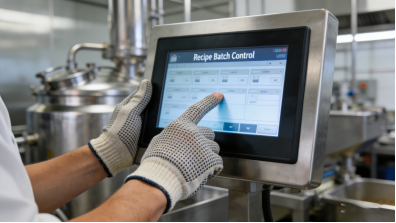
Based on product manual maintenance guidelines and real use experience, these 3 simple tips will extend the life of your industrial resistive touch screen by 50%—no extra cost required:
- Recalibrate Every 3 Months: Recalibrate the screen regularly, or after changing display settings/mounting position, to prevent drift.
- Clean Gently: Use a soft, lint-free cloth and neutral detergent—avoid alcohol, gasoline, or other corrosive cleaners.
- Avoid Extreme Pressure: Operate the screen with moderate force (0.5-1.5N)—don’t use sharp objects (screwdrivers, nails) to press the screen, as this damages the conductive layer.
Final Selection Guide (No Hype, Just Practicality)
Industrial resistive touch screen selection is simple when you focus on your scenario, not “high specs” or marketing claims. Follow these steps to avoid mistakes:
- Assess your scenario: Note temperature range, touch frequency, dust/oil levels, and interface type.
- Match product manual parameters: Choose 4-wire (low-frequency) or 5-wire (high-frequency), operating temperature matching your environment, ≥IP64 protection, and compatible interface.
- Follow maintenance guidelines: Clean gently, recalibrate regularly, and avoid extreme pressure.
The goal is to choose a screen that fits your needs—not the most expensive or “advanced” one. By following these guidelines, you’ll reduce downtime, save budget, and avoid the frustration of frequent touch screen failures. This is the core of industrial selection: practicality over hype, and scenario matching over spec chasing.