

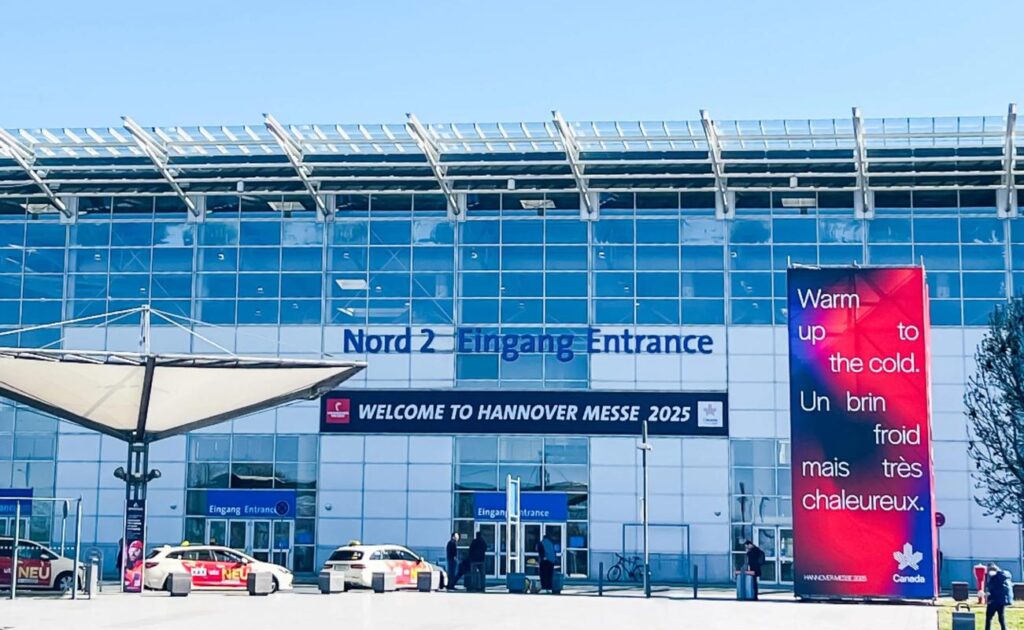
From March 31 to April 4, 2025, the world’s most influential industrial event, Hannover Messe 2025, will be held at the Hannover Exhibition Center in Germany. As a bellwether for global automation and intelligent manufacturing, the exhibition brings together leading companies and innovative technologies from around the world. Industrial touchscreen technology is a highlight of this year’s show.
An industrial touchscreen is a smart terminal that integrates display and human-computer interaction. Its core principle is to sense the position and movement of a user’s finger or stylus on the screen to achieve signal input and control. The internal structure typically includes a display module, a touch sensor layer, a control chip, and protective glass. With advantages such as intuitive operation, responsiveness, and a visual interface, touchscreens are widely used in industrial control systems, medical equipment, in-vehicle displays, smart warehousing, and other fields, bringing efficiency and convenience to industrial scenarios.
Currently, industrial touchscreens are mainly divided into two types: capacitive and resistive. Capacitive screens utilize the body’s electrical conductivity to sense signals, offering advantages such as high light transmittance, sensitive touch, and multi-touch operation. They are suitable for smart manufacturing, automotive, and consumer electronics. Resistive screens, on the other hand, rely on physical pressure-sensing contacts, offering lower costs, glove-operated operation, and strong interference resistance. They are therefore more suitable for environments with high dust levels or strong electromagnetic fields, such as factory floors and medical equipment. Companies should consider the appropriate considerations when selecting a suitable screen based on the intended use and operating habits.
In terms of display lamination, fully bonded (OCA) lamination technology is becoming the industry standard. By fully bonding the touchscreen layer to the display glass, it effectively prevents reflections and dust accumulation caused by the air gap, improving image contrast and visibility, while also enhancing the screen’s waterproof, dustproof, and impact resistance, extending product lifespan.
Looking ahead, the industrial touchscreen industry is entering a new era characterized by flexible displays, antimicrobial materials, and AI-powered intelligent interaction. Flexible screens enable more diverse device form factors; antimicrobial glass meets the hygienic requirements of medical and food applications; and AI-based voice and gesture interaction technologies will further enhance the human-machine collaboration experience.
Touchscreens are becoming a crucial interface in automation, machine control, and logistics equipment. From robot control panels to warehouse sorting terminals and even factory equipment status monitoring systems, smart touch is driving the digitization, visualization, and intelligence of industrial operations.
Furthermore, high-brightness displays are becoming increasingly important for outdoor equipment and high-light scenarios. By utilizing high-brightness backlight modules, optical coatings, and ambient light sensing technologies, these displays remain clearly readable even in bright sunlight, meeting the demands of demanding applications in transportation, energy, and construction sites.
With the accelerating digitalization of global industry, industrial touchscreens are evolving from simple input devices to intelligent interaction hubs. On the global stage of the Hannover Messe, continued innovation in touch technology will undoubtedly inject more intelligence and vitality into the future of manufacturing.