

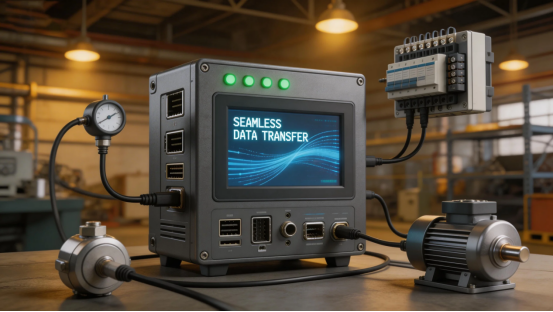
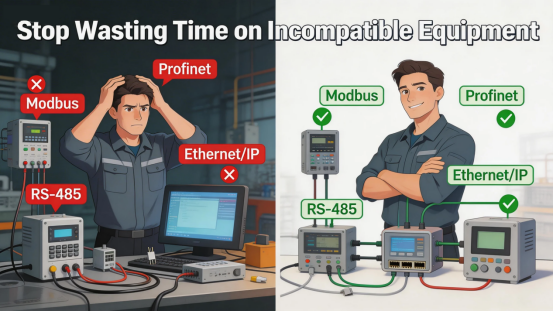
Let’s be real—industrial equipment compatibility is a total nightmare. You’ve got a mix of new and old gear, each using a different protocol (Modbus, Profinet, Ethernet/IP, RS-485)—and none of them talk to each other. You spend hours troubleshooting, calling tech support, or even buying new equipment just to get everything working. Sound familiar? That’s where an industrial protocol converter comes in—it’s the unsung hero that fixes compatibility headaches, no extra work required.
I’ve been in your shoes—trust me. I’ve watched teams spend half a day trying to get a new HMI to talk to an old PLC, only to realize their protocols don’t match. Or worse—they buy a brand-new sensor, only to find out it can’t connect to their existing network. It’s frustrating, it’s a total waste of time, and it’s 100% avoidable. An industrial protocol converter takes 5 minutes tops to set up, works with almost every industrial protocol, and lets all your equipment speak the same language.
This guide isn’t about fancy tech jargon—it’s about saving you from the compatibility chaos we all deal with. We’ll吐槽 the most annoying pain points, break down how protocol converters actually work (in plain English, no fluff), and show you why this tiny device is a must-have for any 我申请 industrial operation with mixed gear.
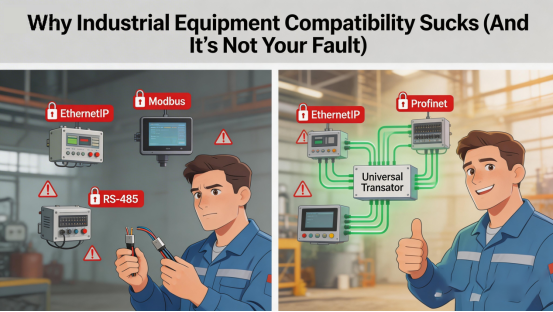
Why Industrial Equipment Compatibility Sucks (And It’s Not Your Fault)
Here’s the harsh truth: Most industrial equipment manufacturers use their own protocols. They don’t care if their gear works with your existing setup—they just want you to buy more of their products. So you end up with a hodgepodge of devices, each speaking a different “language,” and zero way to get them to communicate.
For example: Your new Ethernet/IP PLC can’t talk to your old Modbus sensors. Your Profinet HMI can’t connect to your RS-485 controllers. You’re stuck in a loop of “buy new gear” or “waste time on workarounds”—neither of which is ideal. And let’s not forget the tech support calls—waiting on hold for hours, just to be told “it’s not compatible.” Ugh, total nightmare.
The good news? You don’t have to replace all your equipment or pull your hair out. An industrial protocol converter acts as a “language translator” for your gear—it takes the data from one protocol, converts it to another, and lets all your devices communicate seamlessly. It’s like having a universal translator for your industrial setup, and it’s way easier to use than you think.
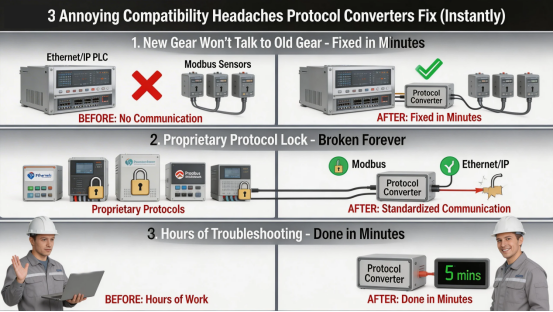
3 Annoying Compatibility Headaches Protocol Converters Fix (Instantly)
If you’re dealing with any of these, you need an industrial protocol converter—like, yesterday. These are the most common compatibility nightmares I see, and how converters fix them in minutes, no stress:
1. New Gear Won’t Talk to Old Gear (The Most Common Frustration)
You just bought a shiny new PLC (Ethernet/IP) to upgrade your facility, but it can’t connect to your old Modbus sensors. You don’t want to replace the sensors—they still work great—but you can’t use the new PLC without them. Enter the industrial Modbus to Ethernet/IP converter: Plug it in, set the protocols, and boom—your new PLC and old sensors are talking like old friends. No workarounds, no tech degree, no stress—just done.
A food processing team I worked with had this exact problem. They bought a new Ethernet/IP HMI but couldn’t connect it to their old Modbus temperature controllers. A protocol converter fixed it in 10 minutes flat—they saved $5,000 on new controllers and 8 hours of pulling their hair out troubleshooting.
2. You’re Stuck with Proprietary Protocols (Thanks, Manufacturers)
Some manufacturers use proprietary protocols—meaning their gear only works with other products from the same brand. So if you have a mix of brands (which most teams do), you’re out of luck. An industrial protocol converter breaks that lock—it can convert proprietary protocols to standard ones (like Modbus or Ethernet/IP), so you’re not stuck with one brand anymore.
A manufacturing team was stuck using only one brand of sensors because they used a proprietary protocol. A protocol converter let them switch to cheaper, more reliable sensors from another brand—saving them $2,000 a year on sensor replacements.
3. Troubleshooting Compatibility Takes Hours (Time You Don’t Have)
Every time you add a new device, you spend hours checking protocols, calling tech support, and testing connections. It’s a huge waste of time—time you could be spending on actual work that moves the needle. An industrial protocol converter simplifies this: It works with almost every protocol, so you can add new gear without stressing about compatibility. Plug it in, configure it, and move on with your day.
The Biggest Mistake Teams Make with Protocol Converters (Don’t Do This!)
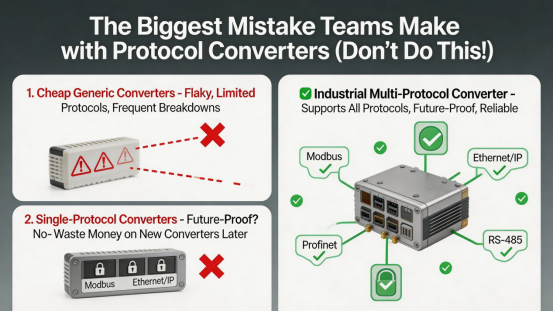
I see this all the time—and it’s such an easy mistake to avoid. Most teams buy a cheap, generic protocol converter online, thinking “it’s the same thing.” Spoiler: It’s not even close. Cheap converters are flaky, don’t support all protocols, and break down fast in industrial environments. They’ll cost you way more in downtime than a quality converter ever would.
Another mistake? Buying a converter that only supports one protocol pair (like Modbus to Ethernet/IP). What if you add a new device with a different protocol later? You’ll have to buy another converter, which is a waste of cash. Instead, go for a industrial multi-protocol converter that supports all the protocols you use (and might use in the future)—future-proof your setup.
What to Look for in an Industrial Protocol Converter (Keep It Simple)
You don’t need a fancy converter—just one that works reliably. Here’s what to focus on (no jargon, just the stuff that actually matters):
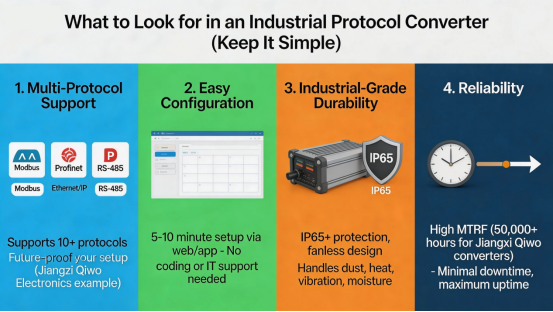
- Multi-Protocol Support: Make sure it supports all the protocols you use (Modbus, Profinet, Ethernet/IP, RS-485, etc.). Top manufacturers like Jiangxi Qiwo Electronics offer converters that support 10+ protocols—future-proof your setup.
- Easy Configuration: Look for a converter with a simple web interface or app—you should be able to set it up in 5-10 minutes, no coding required. Avoid converters that need complicated software or IT support—those are more trouble than they’re worth. This is where industrial protocol converter configuration should be simple, not a headache.
- Industrial-Grade Durability: It needs to hold up in your facility—dust, heat, vibration, and wet conditions. Aim for IP65+ protection and a fanless design (no dust buildup, no overheating).
- Reliability: You don’t want a converter that crashes or disconnects. Look for a high MTBF (Mean Time Between Failures)—the higher, the more reliable it is. Jiangxi Qiwo’s converters have an MTBF of 50,000+ hours—so you won’t have to worry about it failing.
Final Thought: Protocol Converters Save You Time, Money, and Sanity
Industrial compatibility doesn’t have to be a nightmare. An industrial protocol converter is a cheap, simple fix that lets all your gear talk to each other—new or old, any brand, any protocol. It saves you hours of troubleshooting, thousands of dollars on new equipment, and a whole lot of frustration we all could do without.
Ready to end the compatibility chaos once and for all? Request a free demo today—Jiangxi Qiwo will show you how their industrial protocol converters work with your specific gear, and help you pick the right one for your facility. No jargon, no pressure—just a simple solution to your biggest headache.