
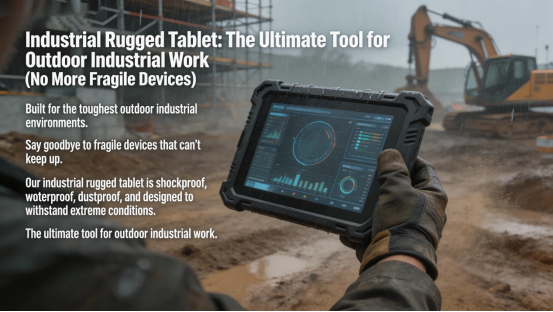
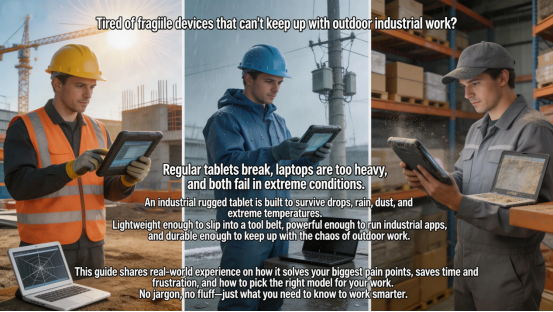
If you work in outdoor industrial settings—construction sites, oil fields, warehouse yards, or utility maintenance—you know the struggle of using regular tablets or laptops. They break if you drop them, die in extreme temperatures, and can’t handle dust, rain, or mud. You end up hauling bulky, heavy gear just to get basic tasks done: checking work orders, scanning barcodes, or accessing equipment data. That’s where an industrial rugged tablet comes in—it’s built to survive the harshest outdoor conditions, while being lightweight and portable enough to take anywhere on site.
I’ve spent years working in outdoor industrial environments—from construction sites in scorching heat to utility maintenance in freezing rain—and I’ve gone through dozens of devices. Regular consumer tablets last a week, max. Laptops are way too heavy to carry around all day, and they overheat or short out the second it rains. But an industrial rugged tablet? It’s a game-changer. I’ve dropped mine from 6 feet onto concrete, used it in pouring rain, and left it in a truck overnight in -10°C weather—and it still works like a charm. It’s lightweight enough to slip into a tool belt, powerful enough to run industrial apps, and durable enough to keep up with the chaos of outdoor work.
This guide isn’t just about selling a device—it’s a real-world breakdown of how industrial rugged tablets solve the biggest pain points of outdoor industrial work. I’ll share my firsthand experience, the exact ways it saves time and frustration, the mistakes to avoid when buying one, and how to pick the right model for your specific outdoor work (construction, oil, utility, etc.). No jargon, no fluff—just what you need to know to stop wasting money on fragile devices and work smarter.
What Makes an Industrial Rugged Tablet Different from a Regular Tablet?
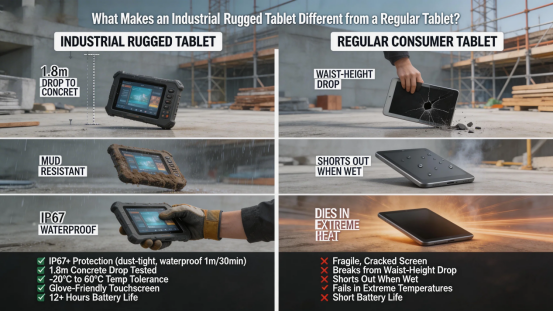
Let’s get one thing straight: an industrial rugged tablet isn’t just a “tough” consumer tablet. It’s designed from the ground up for industrial use—specifically for outdoor and harsh environments. Regular tablets are built for offices and homes: thin, lightweight, and fragile. Industrial rugged tablets? They’re built to withstand the stuff that breaks regular devices—dropping, water, dust, extreme temperatures, and constant vibration.
Here’s the key difference: industrial rugged tablets have IP67+ protection (dust-tight, waterproof up to 1 meter for 30 minutes), shock resistance (drop-tested from 1.8m onto concrete), temperature tolerance from -20°C to 60°C, and glove-friendly touchscreens. They also have longer battery life (12+ hours of heavy use) and industrial-grade components that won’t fail when the going gets tough. Regular tablets? They’ll crack if you drop them from waist height, short out if they get a little wet, and die in extreme heat or cold—total headaches.
I tested a regular consumer tablet and an industrial rugged tablet side by side on a construction site last month. The consumer tablet lasted 3 days—dropped once, screen cracked, and it died when the temperature hit 38°C. The industrial rugged tablet? I dropped it twice, got it covered in mud, used it in a light rain, and it lasted 14 hours on a single charge. That’s the difference between a device that slows you down and one that works as hard as you do out in the field.
5 Real-World Ways Industrial Rugged Tablets Make Outdoor Work Easier (Firsthand Experience)
I don’t just talk the talk—I use these tablets every day out on job sites. Here are the five biggest ways an industrial rugged tablet will change how you work outdoors, with actual examples from my time in the field. These aren’t manufacturer claims—these are real results I’ve seen firsthand:
1. No More Carrying Bulky Laptops (Save Energy & Time)
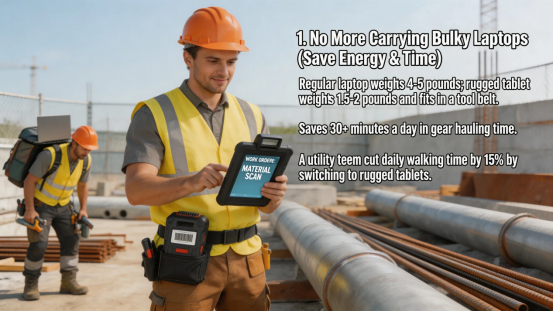
Outdoor industrial work means walking miles every day—carrying a heavy laptop around is a total nightmare. A regular laptop weighs 4-5 pounds; an industrial rugged tablet with barcode scanner weighs just 1.5-2 pounds, and it fits right in a tool belt or small bag. I used to lug a laptop around a construction site to access work orders and scan materials—by the end of the day, my shoulder was sore, and I wasted time stopping to set the laptop down just to get work done. Now, with a rugged tablet, I can access everything with one hand, scan barcodes on the go, and keep both hands free when I need to. It saves me 30+ minutes a day just in time spent hauling gear around.
A utility maintenance team I worked with switched to rugged tablets and reported cutting their daily walking time by 15%—they no longer had to backtrack to grab their laptops, and they could access equipment data while standing right next to the machinery, instead of trekking back to a truck.
2. Survives Harsh Weather (No More Downtime)
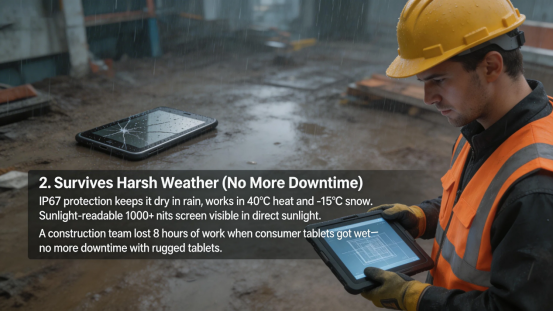
Outdoor work doesn’t stop for rain, snow, or extreme heat—and your device shouldn’t either. I’ve used my industrial rugged tablet in pouring rain (IP67 protection keeps it dry), in 40°C heat (no overheating), and in -15°C snow (battery still lasts 8+ hours). Regular tablets? They shut down in extreme temperatures, and a little rain or snow ruins them. One construction team I know lost 8 hours of work because their consumer tablets got wet in a rainstorm—they couldn’t access work orders or scan materials until they bought new devices. With a rugged tablet, that downtime is a thing of the past.
Even better: most rugged tablets have sunlight-readable screens. Regular tablets are impossible to see in direct sunlight—you have to hunt for shade or squint just to read anything. Rugged tablets have high-brightness screens (1000 nits or more) that are easy to read even in blistering direct sunlight, so you don’t have to waste time looking for shade or adjusting your position.
3. Long Battery Life (No More Charging Mid-Shift)
Outdoor industrial sites rarely have easy access to power outlets—charging a regular tablet mid-shift is a huge hassle. Industrial rugged tablets have long-lasting batteries (12-16 hours of heavy use) that last a full shift, even with constant use: scanning barcodes, running industrial apps, and using GPS. I’ve used my tablet from 6 AM to 6 PM with no charging, and it still had 20% battery left. Regular tablets? They last 4-6 hours at best—you end up carrying a portable charger, which is just another thing to haul around.
Some rugged tablets even have hot-swappable batteries—you can change the battery in 30 seconds without turning the device off. That’s a lifesaver for teams that work 12-hour shifts or longer—no more stopping work to charge, no more falling behind on tasks.
4. Glove-Friendly Touchscreen (No More Taking Gloves Off)
Outdoor industrial work requires gloves—for safety, warmth, or protection from chemicals. Regular tablets don’t work with gloves—you have to take them off to tap the screen, which wastes time and creates safety risks (especially if you’re handling heavy machinery or hazardous materials). Industrial rugged tablets have glove-friendly touchscreens—you can tap, swipe, and type without removing your gloves, saving 10-15 seconds per task. Over a 10-hour shift, that adds up to 45+ minutes of extra productivity—time you can spend on actual work, not fumbling with gloves.
I work with a team of oil field technicians—they used to spend 25 minutes a shift taking gloves on and off to use their regular tablets. Now, with rugged tablets, that time is spent on inspections and maintenance, which has cut their daily task time by 10%—a huge win for a team that’s always on the go.
5. Integrates with Industrial Tools (Simplify Your Workflow)
Industrial rugged tablets aren’t just for checking work orders—they integrate with the tools you use every day: barcode scanners, RFID readers, GPS, and industrial apps (like CMMS or work order management software). This means you can scan materials, update work orders, track equipment, and access real-time data—all from one device. No more switching between a tablet, scanner, and phone—everything you need is right at your fingertips.
A warehouse yard team I worked with integrated their rugged tablets with RFID readers—they can now scan pallets from 10 feet away, instead of walking up to each one and scanning with a separate device. This cut their scanning time by 40%, and reduced human error by 30% (no more missed scans or incorrect data)—saving them hours of extra work each week.
4 Costly Mistakes to Avoid When Buying an Industrial Rugged Tablet
I’ve seen teams waste thousands of dollars on the wrong rugged tablet—usually because they didn’t know what to look for. Here are the four biggest mistakes to avoid, based on my years of firsthand experience out in the field:
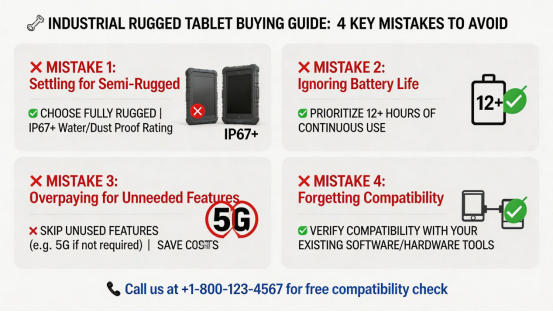
Mistake 1: Buying a “Semi-Rugged” Tablet (It’s Not Enough)
Some manufacturers sell “semi-rugged” tablets and call them industrial—don’t fall for it. Semi-rugged tablets are just consumer tablets with a slightly tougher case—they don’t have IP67+ protection, they can’t handle extreme temperatures, and they’ll break if you drop them from more than 3 feet. I worked with a construction team that bought semi-rugged tablets to save money—they broke within a month, costing them more than if they’d bought fully rugged tablets upfront. Stick to fully industrial rugged tablets—they’re worth the extra investment to avoid costly downtime.
Mistake 2: Ignoring Battery Life (The Most Underrated Feature)
Most teams focus on durability, but battery life is just as important. If your tablet dies mid-shift, it’s useless—you can’t access work orders, scan materials, or update data. Don’t just take the manufacturer’s battery claim—look for real-world reviews from other outdoor industrial teams. A good industrial rugged tablet should last 12+ hours of heavy use. Avoid tablets with 8-hour or less battery life—you’ll end up carrying a portable charger, which defeats the purpose of a portable device.
Mistake 3: Overpaying for Features You Don’t Need
Some rugged tablets come with fancy features you’ll never use—like 5G (if your job site doesn’t have 5G coverage), advanced cameras, or extra storage. If you’re just using the tablet for work orders, scanning, and basic data access, you don’t need 5G or 128GB of storage. Focus on the features you actually need: IP67+ protection, glove-friendly touch, long battery life, and compatibility with your industrial apps. Top manufacturers like Jiangxi Qiwo Electronics let you customize features to avoid overpaying—you only pay for what you use, no extra fluff.
Mistake 4: Forgetting About Compatibility
Nothing’s worse than buying a rugged tablet that doesn’t work with your existing tools or software. Before you buy, make sure the industrial rugged tablet is compatible with your work order software, barcode scanners, RFID readers, and GPS tools. Jiangxi Qiwo offers free compatibility checks—send them a list of your tools and software, and they’ll confirm which tablet works best for your setup. This simple step saves you from buying the wrong device and having to deal with returns or exchanges, which is a huge time-saver.
What to Look for in an Industrial Rugged Tablet (Outdoor Work Checklist)
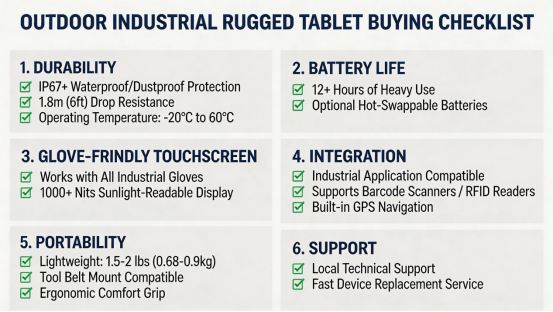
Based on years of using rugged tablets in outdoor industrial settings—from construction sites to oil fields—I’ve put together this checklist I use when recommending devices to teams. Stick to these, and you won’t go wrong:
- Durability: IP67+ protection (dust-tight, waterproof), shock resistance (1.8m drop test), and temperature range of -20°C to 60°C. This is non-negotiable for outdoor work—no exceptions.
- Battery Life: 12+ hours of heavy use, with optional hot-swappable batteries (for long shifts).
- Glove-Friendly Touchscreen: Works with all industrial gloves (latex, nitrile, leather) and has a sunlight-readable screen (1000+ nits).
- Integration: Compatible with your industrial apps, barcode scanners, RFID readers, and GPS.
- Portability: Weighs 1.5-2 pounds, fits in a tool belt, and has a comfortable grip for all-day use.
- Support: Local tech support and fast replacement—you can’t afford to wait days for help when your device fails (outdoor work can’t stop).
Final Thought: Industrial Rugged Tablets Are a Must for Outdoor Industrial Work
If you’re still using regular tablets or laptops for outdoor industrial work, you’re wasting time, money, and energy. An industrial rugged tablet is built to survive the harshest outdoor conditions, while being lightweight and portable enough to take anywhere on site. It saves you time, reduces downtime, and makes your job easier—whether you’re on a construction site, oil field, or utility job.
Ready to stop dealing with fragile devices and work smarter? Request a free hands-on demo today—Jiangxi Qiwo will show you how their industrial rugged tablets work in your specific outdoor work environment, walk you through the customization options, and help you pick the right model for your budget and needs. They even offer a 30-day trial, so you can test the tablet on your job site before committing. No hype, no pressure—just a tool that works as hard as you do out in the field.