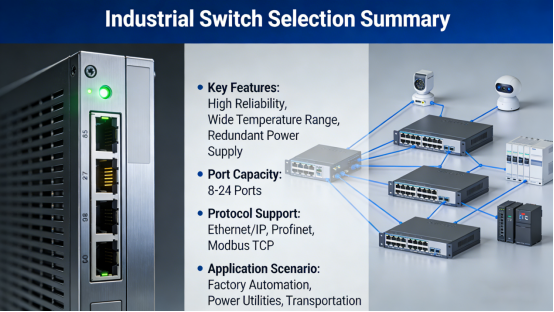

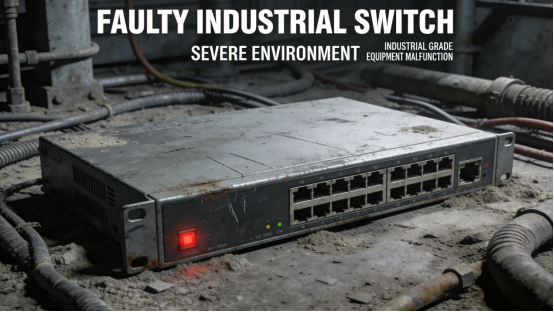
For industrial network engineers, maintenance teams, and purchasers, industrial switches are the “backbone” of industrial communication systems—yet their frequent failures in harsh industrial environments often go unaddressed. Unstable network connections, data loss, device disconnections, and sudden shutdowns disrupt production scheduling, drive up troubleshooting and maintenance costs, and even compromise the entire industrial IoT system’s normal operation.
The root cause of these failures isn’t poor product quality—it’s choosing an ordinary commercial switch instead of a professional industrial switch. Industrial sites present unique challenges: electromagnetic interference, extreme temperature swings, dust, vibration, and unstable power supplies—conditions commercial switches (designed for offices or data centers) simply can’t withstand.
This article offers objective, fact-based guidance aligned with official product manuals and industrial technical standards. We’ll cover key differences between industrial and commercial switches, core selection criteria for harsh environments, and common application mistakes to avoid—no marketing jargon, no sales pitches, no exaggerated claims, just actionable tips to help you choose a stable, durable industrial switch that reduces failures and ensures smooth industrial communication.
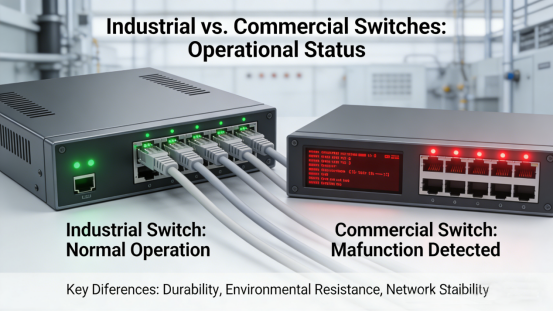
Key Differences Between Industrial Switches and Commercial Switches
Many professionals mistakenly assume “a switch is just a switch,” but industrial and commercial switches differ fundamentally in design, performance, and adaptability. Industrial switches are engineered to solve industrial communication pain points, with core advantages commercial switches can’t match (per product manual specs):
- Strong anti-electromagnetic interference (EMI) capability: Resists interference from industrial equipment like motors, frequency converters, and high-voltage devices, ensuring stable data transmission.
- Wide temperature adaptability: Works stably in extreme cold and heat, avoiding failures caused by temperature fluctuations in industrial workshops.
- Rugged structural design: Dust-proof, waterproof, and vibration-resistant, adapting to the harsh physical environment of industrial sites.
- Stable power supply support: Withstands power grid fluctuations and has multiple protection functions to avoid damage from voltage spikes or power outages.
- Long-term continuous operation: Designed for 24/7 uninterrupted work, meeting the high-reliability requirements of industrial communication systems.
For industrial communication systems—such as industrial IoT, automated production lines, and factory monitoring—choosing a commercial switch over an industrial one is a hidden risk that will eventually lead to costly failures.
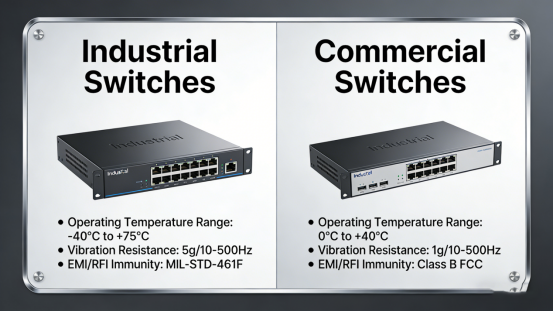
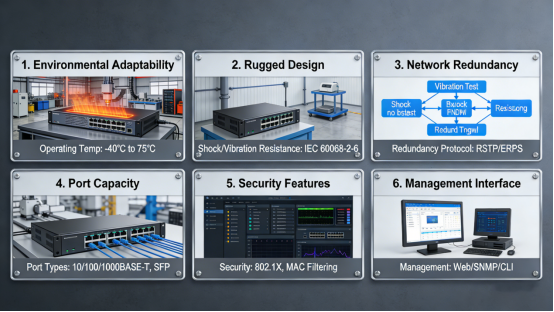
6 Core Selection Points for Industrial Switches (From Product Manuals)
To choose an industrial switch that operates stably in harsh industrial environments, focus on these six core criteria—all verified by official product manuals and real-world application experience. These indicators directly determine the switch’s stability and service life:
1. Anti-Electromagnetic Interference (EMI) Performance
Electromagnetic interference is the top cause of industrial switch failure. A reliable industrial switch must meet EMC/EMI certification standards (e.g., CE, FCC), with a minimum interference resistance level of 10V/m (per product manual specs).
This ensures stable operation near high-interference industrial equipment, free from signal loss, packet loss, or network disconnection—critical for real-time data transmission in industrial systems.
2. Operating Temperature Range
Industrial workshops often have extreme temperature fluctuations, from freezing winters to sweltering summers. A high-quality industrial switch should support a working temperature range of -40°C to 85°C (per product manual)—far wider than commercial switches (typically 0°C to 40°C).
This wide range guarantees stable operation in extreme conditions, preventing failures like startup issues, network interruptions, or component damage caused by temperature extremes.
3. Protection Rating (Dust & Waterproof)
Industrial sites are often dusty, and some areas face water splashes or high humidity. An industrial switch’s protection rating directly determines its adaptability to these environments. Per product manual guidelines:
- For cabinet-mounted switches: Choose IP20 or higher to prevent dust from entering and damaging internal components.
- For on-site installation (e.g., outdoor monitoring, workshop production lines): Choose IP65 or higher to achieve full dust-proof and waterproof protection, adapting to harsh on-site conditions.
4. Vibration Resistance
Industrial machinery generates continuous vibration during operation, which can loosen the switch’s internal components and cause failure. A reliable industrial switch should have a vibration resistance of 10-500Hz (per product manual), with 15g (peak value) shock resistance—ensuring stable operation even in high-vibration environments.
5. Power Supply Adaptability & Protection
Industrial power grids are often unstable, so the industrial switch should support a wide voltage input range (e.g., 12-36V DC, per product manual) to adapt to fluctuations and ensure a stable power supply.
It should also have comprehensive power protection: over-voltage, over-current, short-circuit, and reverse polarity protection—preventing damage to the switch and connected devices from power abnormalities.
6. Port Configuration & Compatibility
An industrial switch’s port configuration must match your industrial communication system’s actual needs. Before purchasing, confirm these details (per product manual):
- Port type: Supports Ethernet ports (10/100/1000Mbps) that match your industrial devices (e.g., sensors, cameras, PLCs).
- Port quantity: Ensure sufficient ports for current devices, and reserve 20-30% of spare ports for future expansion.
- Special functions: If long-distance transmission is needed, choose a switch with fiber optic ports; if network redundancy is required, select a switch that supports ring network protection (e.g., RSTP/MSTP).
4 Common Mistakes to Avoid (Save Time & Money)
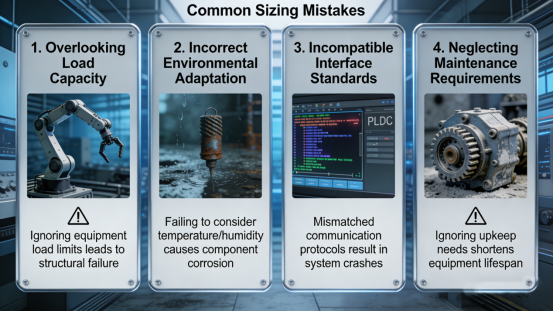
Based on real industrial communication experience, these four mistakes are the most common causes of industrial switch failures. Avoid them to maximize your industrial network’s stability:
Mistake 1: Using Commercial Switches in Industrial Environments
Commercial switches lack anti-interference, temperature adaptability, and protection functions. They may work temporarily in industrial sites but fail quickly, leading to network interruptions and costly replacements.
Mistake 2: Ignoring the Protection Rating
Choosing a switch with a low protection rating (e.g., IP20 for on-site installation) leads to dust or water damage. Always match the protection rating to the installation environment, following product manual guidance.
Mistake 3: Underestimating Port Expansion Needs
Choosing a switch with insufficient ports forces costly, unstable later expansion. Always reserve 20-30% spare ports based on future expansion plans.
Mistake 4: Skipping Power Supply Protection Checks
Industrial power fluctuations are common—switches without power protection are easily damaged by voltage spikes or short circuits. Always check power protection specs in the product manual before purchasing.
Conclusion: Choose Industrial Switches for Stability & Durability
Industrial switches aren’t just “enhanced commercial switches”—they’re specialized components engineered for harsh industrial environments. The key to choosing a reliable one is to prioritize anti-interference performance, environmental adaptability, power stability, and port compatibility, not just price or brand.
By following the selection criteria and avoiding common mistakes outlined here—all aligned with official product manuals and industrial standards—you’ll select an industrial switch that operates stably in harsh environments, reduces network failures, lowers maintenance costs, and ensures your industrial communication system runs smoothly.
This article provides objective, practical guidance for industrial professionals—no promotions, no sales pitches, no exaggerated claims, just fact-based tips to help you choose an industrial switch that never lets your network down.