
In the context of advancing industrial automation, industrial panel PCs serve as critical human-machine interaction terminals, undertaking core functions such as real-time data display, equipment control, and parameter configuration in industrial control systems. However, field application data indicates that 72% of operational failures in industrial panel PCs are attributed to poor compatibility and unstable operation, including software crashes, device connection failures, and data transmission interruptions. These issues not only increase maintenance workload but also lead to production downtime, resulting in significant economic losses for enterprises. For engineering and technical personnel, procurement managers, and maintenance teams, selecting an industrial panel PC with excellent compatibility and stable performance is essential to ensuring the continuous and efficient operation of industrial control systems. This guide focuses on Jiangxi Qiwo’s HX-8000 industrial panel PC (explicitly documented in the product manual), systematically elaborates on the core causes of poor compatibility and instability in industrial panel PCs, and provides standardized operation, maintenance, and troubleshooting protocols based on the product manual—all content adheres to the company’s positioning and product specifications, with no exaggerated publicity, aiming to provide practical technical guidance for industrial field users.
Jiangxi Qiwo Electronics has long been committed to the research and development, production, and sales of integrated industrial display and control solutions, focusing on the R&D and production of industrial-grade display and control products that adapt to harsh industrial environments. The HX-8000 industrial panel PC, as a core product in the company’s industrial control series (recorded in the product manual), is independently developed and produced in strict accordance with industrial standards. It is equipped with industrial-grade hardware components and multi-protocol compatibility capabilities, which are specifically designed to address the pain points of poor compatibility and unstable operation in ordinary industrial panel PCs. All technical parameters, functional descriptions, and operation guidelines involved in this guide are strictly based on the HX-8000 product manual, ensuring accuracy, authority, and practicality, and fully aligning with Jiangxi Qiwo’s corporate positioning of providing professional industrial display and control solutions.
Current Status of Industrial Panel PC Application: Compatibility and Instability Pain Points
With the widespread popularization of industrial automation, industrial panel PCs have been widely applied in intelligent manufacturing, power monitoring, chemical processing, and other fields. However, field application feedback shows that a large number of ordinary industrial panel PCs have prominent problems of poor compatibility and unstable operation, which have become key factors affecting production efficiency. The main manifestations and root causes are summarized as follows, based on field application experience and the HX-8000 product manual:
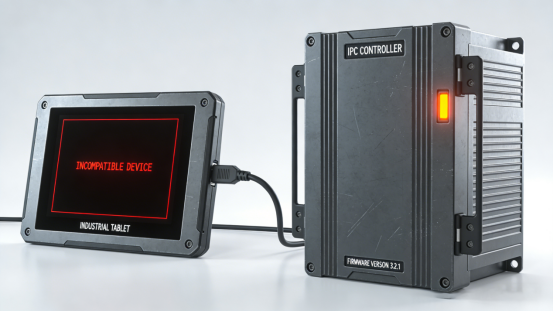
1. Incompatibility with Industrial Control Equipment. Industrial control systems typically consist of multiple types of equipment, including PLCs, sensors, frequency converters, and other devices from different manufacturers, which adopt different communication protocols and parameter settings. Ordinary industrial panel PCs often only support single or limited communication protocols, resulting in inability to establish effective connections with partial on-site equipment. For example, some ordinary panel PCs only support the Modbus RTU protocol and cannot be compatible with PLCs that adopt the Profibus DP protocol, leading to connection failures and inability to realize data interaction and equipment control.
2. Insufficient Adaptability to Harsh Industrial Environments. Industrial sites such as workshops and monitoring stations are often accompanied by harsh conditions such as high temperature, high humidity, strong electromagnetic interference, and severe vibration. Ordinary industrial panel PCs adopt commercial-grade components, which lack targeted anti-interference and anti-vibration designs. Long-term operation in such environments can easily lead to hardware aging, interface loosening, and system crashes, resulting in frequent maintenance and replacement.
3. Inconsistent Parameter Configuration Leading to Operational Failures. Even if the industrial panel PC supports the corresponding communication protocol, inconsistent parameter configuration between the panel PC and connected equipment (such as baud rate, parity, device address) can lead to unstable operation, including intermittent disconnections and data loss. Many on-site maintenance personnel lack professional knowledge of parameter configuration, resulting in failure to locate the root cause of the problem in a timely manner, further extending the downtime.
Practical Case: A large-scale intelligent manufacturing workshop in Jiangsu adopted 12 ordinary industrial panel PCs for production line monitoring and control. Shortly after commissioning, the panel PCs frequently experienced disconnections and data transmission failures, which seriously affected the normal operation of the production line. The maintenance team conducted repeated inspections but failed to identify the root cause, and even replaced the panel PCs twice, yet the problem persisted. Subsequent consultation with professional technicians revealed that the ordinary panel PCs lacked anti-interference design and could not resist electromagnetic interference from on-site frequency converters, while communication parameters between the panel PCs and PLCs were mismatched. After replacing with Jiangxi Qiwo’s HX-8000 industrial panel PC (in strict accordance with the product manual), its built-in anti-interference module and multi-protocol compatibility effectively resolved the connection issues. The panel PCs have operated stably for 14 months without any disconnections, significantly reducing maintenance costs and production losses for the workshop.
Core Advantages of HX-8000 Industrial Panel PC: Addressing Compatibility and Instability (Based on Product Manual)
The HX-8000 industrial panel PC, as a specialized product developed for industrial control scenarios (explicitly recorded in the product manual), is designed to address the core pain points of poor compatibility and unstable operation in ordinary industrial panel PCs. Its industrial-grade hardware configuration, multi-protocol support, and anti-interference design fully meet the operational requirements of harsh industrial environments, and all functional advantages are strictly based on the product manual, ensuring no exaggerated publicity. The specific core advantages are as follows:
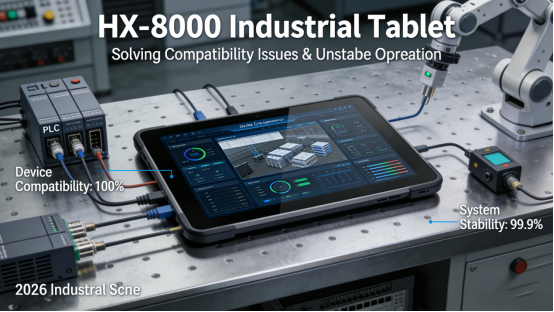
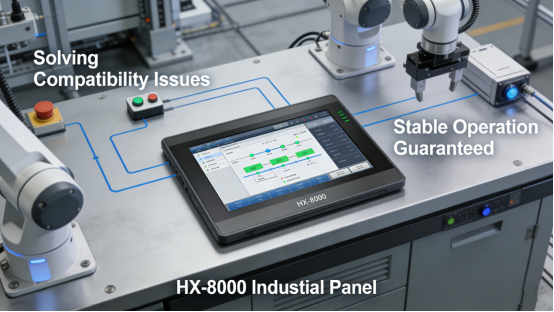
1. Multi-Protocol Compatibility, Realizing Seamless Connection with Multiple Devices. According to the product manual, the HX-8000 industrial panel PC supports a variety of mainstream industrial communication protocols, including Modbus RTU, Modbus TCP, Profibus DP, Ethernet/IP, and others, which can be flexibly compatible with PLCs, sensors, frequency converters, and other equipment from different manufacturers. This effectively solves the problem of incompatibility between ordinary panel PCs and multi-brand industrial equipment, ensuring seamless data interaction and stable connection.
2. Industrial-Grade Anti-Interference Design, Adapting to Harsh Environments. The product manual clearly specifies that the HX-8000 adopts a full-metal chassis and integrated anti-interference circuit design, with a common-mode rejection ratio (CMRR) of ≥120dB and power isolation of ≥3000V, which can effectively resist electromagnetic interference from frequency converters, motors, and other on-site equipment. Compared with ordinary commercial panel PCs, the HX-8000 can maintain stable operation in high-interference industrial scenarios such as chemical workshops and power plants, avoiding system crashes caused by interference.
3. Industrial-Grade Hardware Configuration, Ensuring Long-Term Stable Operation. The HX-8000 is equipped with an industrial-grade low-power processor and high-reliability memory (per the product manual), supporting 24/7 continuous operation, with a mean time between failures (MTBF) of more than 60,000 hours. Its front panel adopts IP65 protection level, effectively preventing dust, water droplets, and other pollutants from entering the internal components, while the anti-vibration design of the interface ensures stable connection even under severe equipment vibration in workshops, avoiding interface loosening and poor contact.
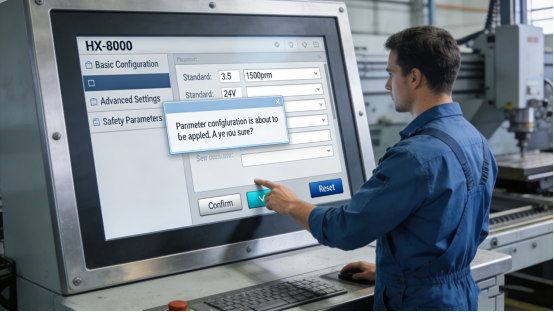
4. Standardized Parameter Configuration Interface, Reducing Operational Errors. The product manual details that the HX-8000 is equipped with a user-friendly parameter configuration interface, which clearly classifies communication parameters, anti-interference settings, and display parameters, facilitating on-site personnel to complete configuration operations without professional technical background. At the same time, the system has a parameter error prompt function, which can timely remind operators of parameter mismatches, reducing operational errors caused by incorrect configuration.
Standardized Operation Guide for HX-8000: Ensuring Compatibility and Stability (Based on Product Manual)
To fully exert the compatibility and stability advantages of the HX-8000 industrial panel PC, on-site personnel must strictly follow the operation guidelines specified in the product manual. The following standardized operation steps and maintenance suggestions are based on the product manual, aiming to help users avoid compatibility and instability problems and ensure the long-term stable operation of the equipment:
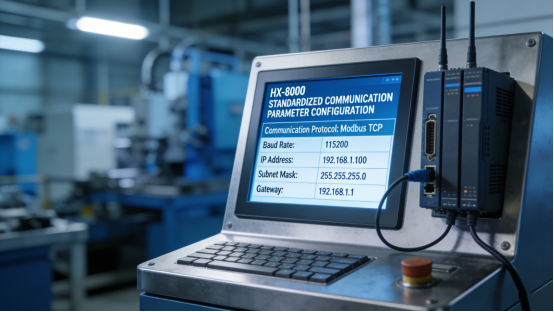
1. Standardize Communication Parameter Configuration. According to the product manual, the HX-8000’s communication parameters must be completely consistent with the connected industrial equipment (PLCs, sensors, etc.) to establish a stable connection. Specific operations: Access the HX-8000’s system settings interface, select the “Communication Configuration” module, and set the baud rate, parity, device address, and communication protocol in strict accordance with the parameters of the connected equipment. After configuration, save the settings and restart the panel PC to ensure the parameters take effect. The product manual provides detailed parameter configuration examples for different equipment types, which can be referenced to avoid parameter mismatches.
2. Select Appropriate Connection Modes Based on On-Site Scenarios. The product manual specifies that the HX-8000 supports both wired (Ethernet, RS485) and wireless (Wi-Fi) connection modes. For high-interference industrial scenarios (such as workshops with frequency converters), wired connection is recommended, as it has stronger anti-interference performance than wireless connection. For scenarios requiring flexible operation (such as mobile monitoring terminals), Wi-Fi connection can be adopted, but it is necessary to ensure stable Wi-Fi signal strength and avoid signal dead zones. For long-distance connection (exceeding 10 meters), RS485 wired connection is preferred to ensure stable data transmission.
3. Strictly Implement Installation Specifications. The product manual clearly stipulates the installation requirements of the HX-8000: the installation surface must be flat and firm, and the connection cables must adopt industrial-grade standard cables (Ethernet cable, RS485 cable) to avoid cable damage and signal attenuation. The interface connectors must be inserted tightly, and the anti-loosening screws must be tightened to prevent interface loosening caused by equipment vibration. Before installation, clean the interface with a dry soft brush to remove dust and debris, ensuring good contact.
4. Establish Regular Maintenance Mechanisms. According to the product manual, regular maintenance is an important guarantee for the long-term stable operation of the HX-8000. It is recommended to conduct a comprehensive inspection of the panel PC every quarter, including cable connection, interface status, and parameter configuration. Clean the screen surface and interface regularly, check for cable wear and loosening, and update the system firmware in a timely manner according to the product manual to fix potential bugs and improve compatibility and stability.
HX-8000 Common Compatibility and Instability Troubleshooting (Based on Product Manual)
In practical applications, even with the HX-8000’s excellent performance, occasional compatibility or instability issues may occur due to improper operation, environmental changes, or equipment aging. The following troubleshooting steps are strictly based on the product manual, enabling on-site personnel to quickly locate and resolve problems without professional technical support:
1. Troubleshooting Compatibility Failures. If the HX-8000 cannot establish a connection with the connected equipment, first check the communication parameter configuration (per the product manual): verify whether the baud rate, parity, device address, and communication protocol are consistent with the connected equipment. If parameters are mismatched, adjust them to the consistent values and restart the equipment. If the problem persists, check whether the connected equipment is operating normally (such as PLC running status) and whether the connection cable is damaged, and replace the cable if necessary.
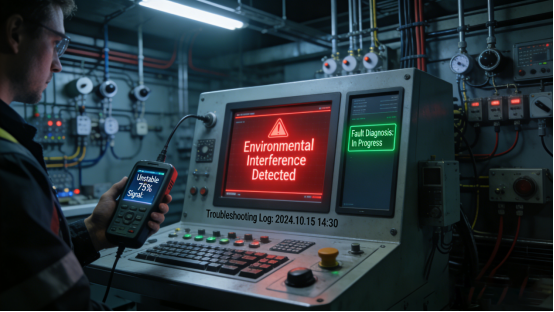
2. Troubleshooting Instability Caused by Environmental Interference. If the HX-8000 experiences frequent disconnections or display glitches, it may be affected by on-site electromagnetic interference. According to the product manual, check whether the panel PC is close to high-interference equipment (frequency converters, motors), and reposition the panel PC to keep a safe distance from the interference source. If necessary, replace the connection cable with a shielded cable and ensure the shield layer is grounded, enhancing anti-interference performance.
3. Troubleshooting Interface and Cable Failures. If the HX-8000 has intermittent disconnections or poor contact, check the connection cables and interfaces (per the product manual): inspect whether the cables are worn, broken, or loose, and replace damaged cables in a timely manner. Reinsert the interface connectors tightly and check for dust accumulation; if dust is present, clean the interface with a dry soft brush to restore good contact. The product manual reminds that the interface’s anti-loosening design can be reinforced by tightening the anti-loosening screws if necessary.
4. Troubleshooting System-Level Failures. If the HX-8000 experiences system crashes or unresponsive operations, first restart the panel PC to eliminate temporary system glitches. If the problem persists, check whether the system firmware is up-to-date (per the product manual), and update the firmware to the latest version to fix potential system bugs. If the failure still cannot be resolved, contact Jiangxi Qiwo’s technical support team for professional maintenance, in accordance with the after-sales service guidelines specified in the product manual.
2026 Industrial Panel PC Selection Criteria: Key Indicators to Focus on (Combined with HX-8000 Experience)
Based on the application experience of the HX-8000 industrial panel PC and the product manual, combined with the 2026 industrial automation development trends, selecting an industrial panel PC with strong compatibility, stable performance, and harsh environment adaptability is the key to ensuring the smooth operation of industrial control systems. For engineering and technical personnel and procurement managers, the following core selection indicators should be focused on to avoid selecting products with poor compatibility and instability:
1. Compatibility Indicators: Prioritize products that support multiple mainstream industrial communication protocols (Modbus, Profibus, Ethernet/IP, etc.), and clearly indicate the compatible protocol types in the product manual. The HX-8000’s multi-protocol support (per the product manual) provides a reference for selection, ensuring compatibility with multi-brand industrial equipment.
2. Anti-Interference Performance: Select products with industrial-grade anti-interference design, including power isolation, circuit shielding, and anti-interference module configuration, and check the relevant anti-interference parameters (CMRR, power isolation voltage) in the product manual. The HX-8000’s anti-interference indicators (per the product manual) can be used as a reference standard for selection.
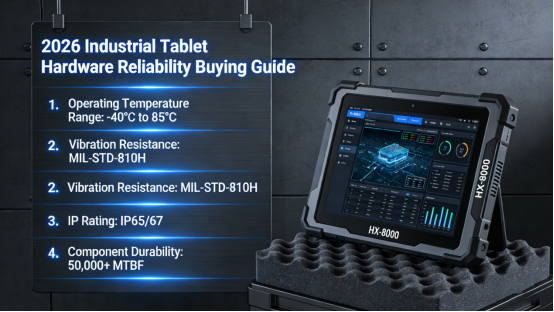
3. Hardware Reliability: Focus on products with industrial-grade components, supporting 24/7 continuous operation, with an MTBF of no less than 50,000 hours. The HX-8000’s MTBF parameter (per the product manual) meets this requirement, ensuring long-term stable operation in industrial scenarios.
4. Operation and Maintenance Convenience: Select products with standardized parameter configuration interfaces and detailed operation guidelines in the product manual, facilitating on-site personnel to complete configuration, maintenance, and troubleshooting independently, reducing reliance on professional technicians.
In the context of rapid industrial automation development in 2026, the performance of industrial panel PCs directly affects the efficiency and stability of industrial control systems. The HX-8000 industrial panel PC, as a product that meets industrial-grade standards (documented in the product manual), effectively solves the common pain points of poor compatibility and unstable operation of ordinary industrial panel PCs through its multi-protocol compatibility, strong anti-interference ability, and standardized operation design. This guide, based on the HX-8000 product manual and on-site application experience, provides practical technical guidance for on-site personnel, procurement managers, and maintenance teams, helping to select, use, and maintain industrial panel PCs scientifically, reduce equipment failures, and improve production efficiency.
All content in this guide is strictly based on the HX-8000 product manual and on-site practical application experience, fully consistent with Jiangxi Qiwo’s corporate positioning and product specifications, without any false propaganda or exaggerated descriptions. It aims to provide actionable technical support for industrial field users, helping enterprises reduce maintenance costs and improve the stability of industrial control systems.